
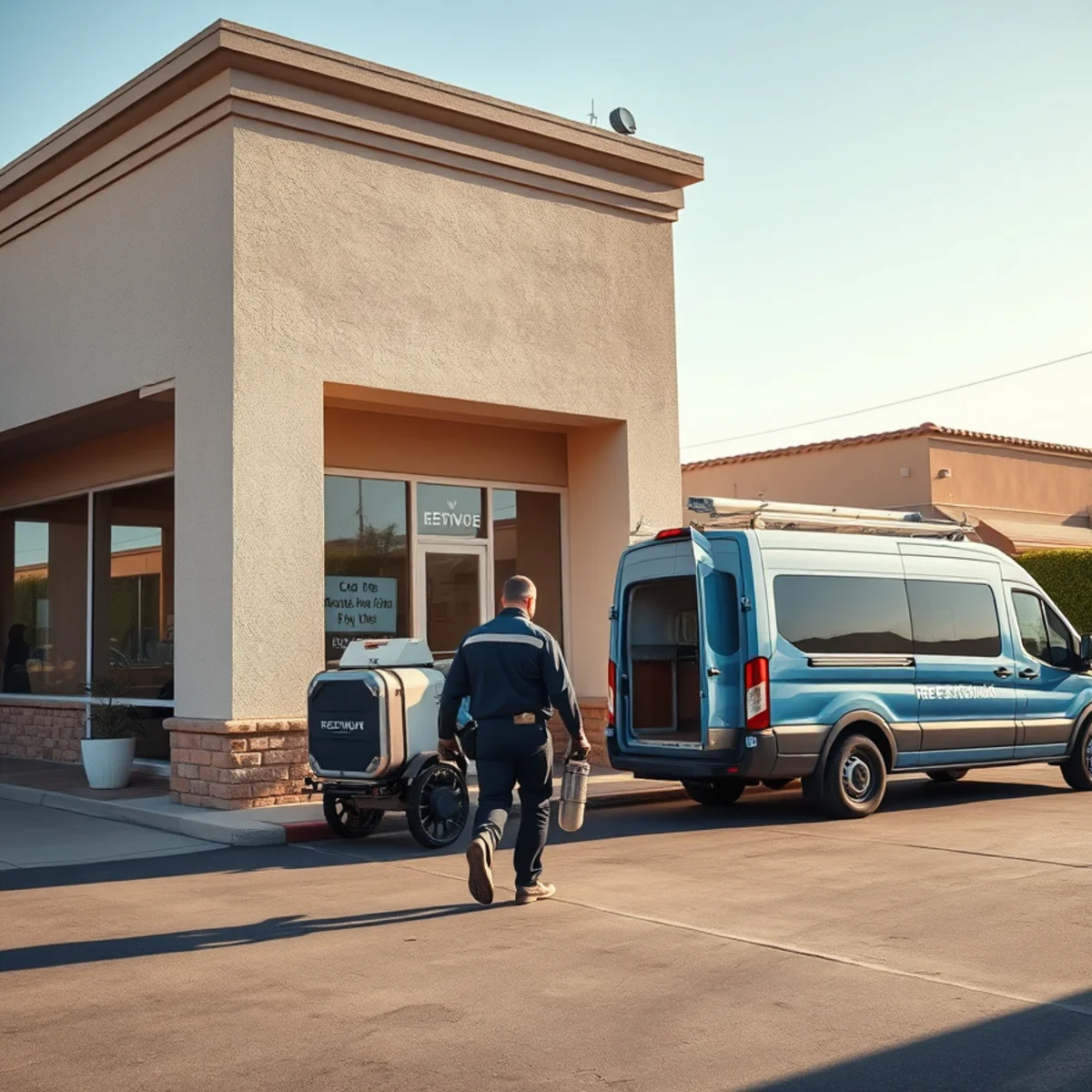
Core service area
Water Damage Restoration on the Imperial Highway Corridor, Downey, CA
Imperial Highway is one of the main east-west routes across southern Downey, and the building stock along it is almost entirely 1960s and 70s commercial and multi-family — strip retail, small offices, and apartment blocks.
- Open 24/7
- 60-minute emergency dispatch
- about 11 minutes from our Florence Ave base
- IICRC S500 standard
That construction era shares two vulnerabilities, and both show up in our call log every winter. Flat and low-slope roofs that drain rather than shed. And shared plumbing stacks serving many units through pipe that is now fifty-plus years old.
We work both sides of this corridor: the retail tenants who cannot afford to close, and the property managers dealing with a leak that started in unit 12 and is now showing up in units 8 and 4.
Flat Roofs and Shared Stacks
Flat roofs on this corridor are the seasonal problem. They rely on internal drains and scuppers rather than slope, and when those block with debris, water ponds. Ponding water weighs roughly five pounds per square foot per inch, and it works into every seam and flashing detail it sits on. On a 1960s–70s built-up roof that has been patched repeatedly, that is a lot of opportunity.
The rule we give property managers is simple: if water is still standing on the roof 48 hours after a storm, the drainage is not working and it needs attention before the next front, not in spring.
Shared plumbing stacks are the year-round problem. In a multi-unit building, many apartments feed a common vertical stack. A blockage low in that stack backs up into the lowest fixtures — which are usually not in the unit that caused it. So the tenant with sewage coming up through their shower is frequently the victim of something happening three floors up.
Supply-side failures behave the same way in reverse. A leak in an upper unit runs down through the floor assembly and appears in the ceiling of the unit below, often a room away from the source.
What we handle on this corridor:
- Flat and low-slope roof ponding and seam failures during winter storms
- Shared plumbing stack backups affecting lower units
- Supply leaks migrating down through floor assemblies between apartments
- Category 3 sewage cleanups in multi-family units
- Retail tenant losses where closure costs exceed restoration costs
- HVAC condensate overflow into ceiling grids and units below
Multi-Unit Losses Need a Different Approach
The mistake that makes multi-family losses expensive is treating them as one unit's problem. Water in attached construction travels, and by the time a second tenant reports damage the assembly between them has usually been wet for a while.
On any multi-unit call our first move after making the space safe is to ask for access to the units below and adjacent, and meter them whether or not anyone has reported anything. It regularly turns up moisture in a unit whose tenant has noticed nothing. Finding it that day means drying an assembly. Finding it in week six means drywall removal and mold remediation in an occupied apartment, which is a substantially worse conversation for everyone.
One property on this corridor had a supply failure in a second-floor unit overnight. Obvious damage in that unit and in the ceiling below. We metered the two units either side as well — one read wet nearly the width of the party wall. Four units dried on one job, no demolition in three of them, and no surprise call in November.
For property managers the practical takeaway is to authorize access to adjacent units early. The hour spent getting keys is worth far more than it costs.
Landmarks and streets we work around
- Imperial Highway
- Rancho Los Amigos National Rehabilitation Center on Imperial Hwy
- Kaiser Permanente Downey Medical Center
- Lakewood Boulevard
- Paramount Boulevard
- Downey Landing
Response and coverage
- Drive time
- about 11 minutes from our Florence Ave base
- Dispatch
- 60-minute emergency dispatch, 24/7
- ZIP codes
- 90242, 90241
What we handle most in Imperial Highway Corridor
These are the services this area calls us for. We offer all 16 everywhere we work.
Why Imperial Highway Corridor Residents Choose Us
About eleven minutes out, working both sides of this corridor — retail tenants and property managers.
We meter the units below and beside, always
Water in attached construction travels through floor assemblies and party walls. On one four-unit job we dried four apartments from one supply failure, with no demolition in three of them.
We know the flat-roof failure mode
1960s–70s commercial here drains rather than sheds. Ponding weighs about five pounds per square foot per inch and works into every seam. Standing water 48 hours after rain means the drainage is not working.
We give per-unit completion dates
A manager needs to tell each tenant something true. One combined estimate for the building is not useful to anyone.
Imperial Highway Corridor questions we get asked
Not after 48 hours. Roof drains and scuppers should clear a low-slope roof within a day or two of rain stopping. Water still standing beyond that means the drainage is blocked or the roof has deflected into a low point — and ponding weighs about five pounds per square foot per inch while working into every seam. Get it cleared and inspected before the next front rather than waiting for spring.
That is common in buildings with shared stacks — a blockage low in the system backs up into the lowest fixtures, which are frequently not in the unit that caused it. Report it to management immediately and stay out of the affected area; it is Category 3 water regardless of origin. The building typically handles the line and the structural cleanup, while your renters or condo policy covers your contents.
We ask for it, yes, and it matters. Water in attached construction travels through floor assemblies and party walls, and adjacent units are wet more often than their occupants realize. Metering them on day one usually means drying in place with no demolition. Finding it six weeks later means opening walls in an occupied apartment and remediating mold.
Usually at least partly. We contain the affected zone so unaffected floor area keeps trading, and schedule the disruptive stages outside business hours where the timeline allows. Full closure is sometimes unavoidable with contaminated water or a large affected area — and we will tell you that on day one so you can plan, rather than discovering it midway through.
Not after 48 hours. Roof drains and scuppers should clear a low-slope roof within a day or two of rain stopping. Water still standing beyond that means drainage is blocked or the roof has deflected into a low point — and ponding weighs roughly five pounds per square foot per inch while working into every seam. Get it cleared before the next front rather than waiting for spring.
That is common in buildings with shared plumbing stacks — a blockage low in the system backs up into the lowest fixtures, which are frequently not in the unit that caused it. Report it to management immediately and stay out of the affected area; it is Category 3 water regardless of origin. The building typically handles the line and the structural cleanup, while your renters policy covers your contents.
Dispatching to Imperial Highway Corridor, Downey from our Downey base
8615 Florence Ave, Downey, CA 90240 — about 11 minutes from our Florence Ave base.
Visit or call us
Downey, CA 90240
Nearby areas we also serve
Water damage in Imperial Highway Corridor? Call now.
about 11 minutes from our Florence Ave base. We answer 24/7 and dispatch within 60 minutes across Downey, CA and the surrounding Gateway Cities.
- Open 24/7
- 60-minute emergency dispatch
- IICRC S500 standard
- Bonded & insured
8615 Florence Ave, Downey, CA 90240
+1 (201) 277-9344 · Get Directions