
6 min read
How Fast Does Mold Grow After a Leak? Inside the 24–48 Hour Window
The 24 to 48 hour figure gets quoted constantly and rarely explained. Here is what is actually happening, and what it means for your decisions.
Read article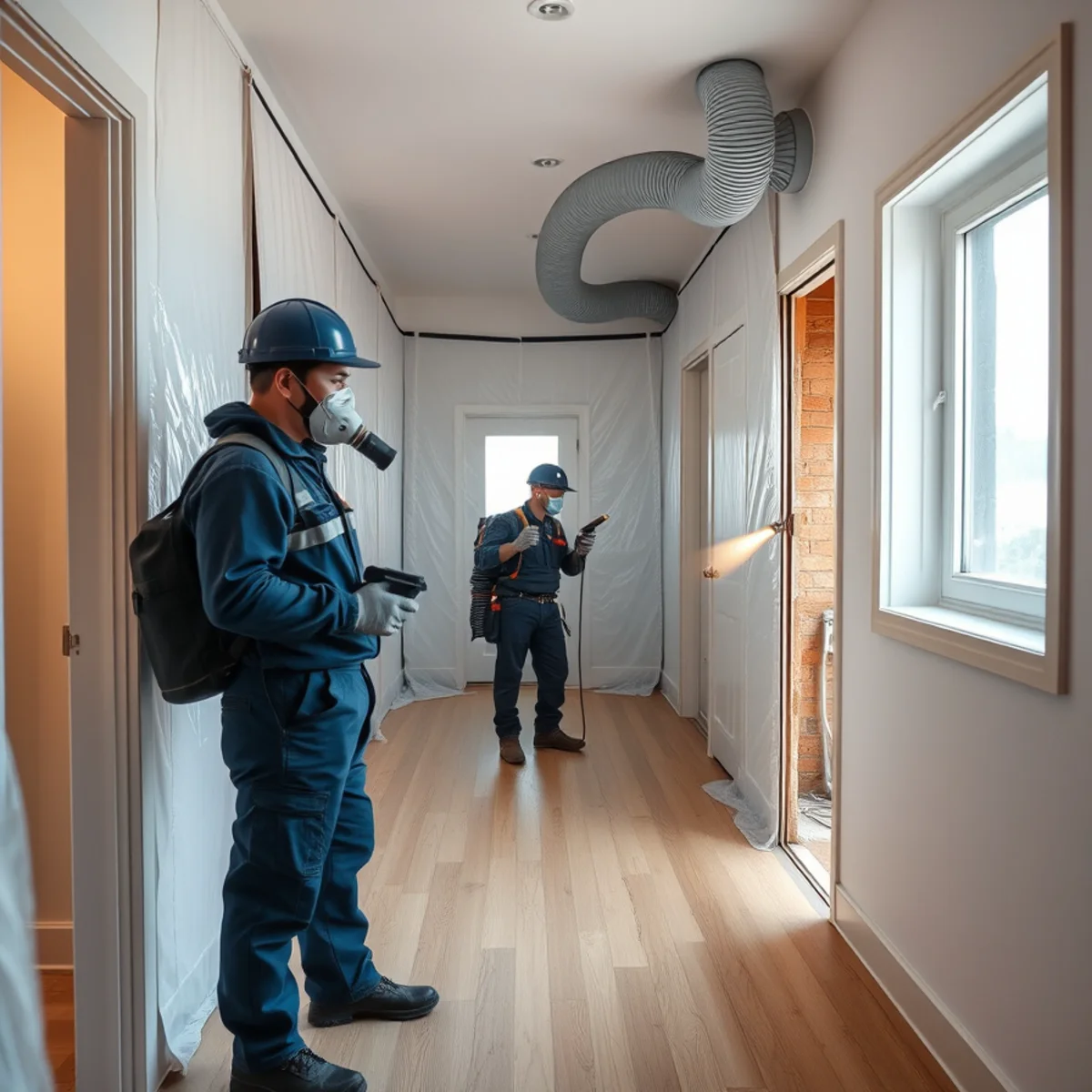
Core restoration service
Mold is not the disease. It is the symptom. Something in your house is wet, and until that changes, everything else is temporary.
That is the part most homeowners are never told. Spraying a wall, wiping it down, painting over it — all of that removes what you can see and none of what matters. Mold grows on a food source (drywall paper, wood, dust) in the presence of moisture. Remove the moisture and it cannot grow. Leave the moisture and it will be back in the same spot within weeks, usually worse, because now it is behind fresh paint where you cannot watch it.
We work the problem in the right order: find the water, stop the water, contain the area, remove what is contaminated, and verify. If we cannot find a moisture source, we say so and keep looking rather than starting demolition.
Mold can begin colonizing wet material within 24 to 48 hours. These are what we see most often in Downey homes:
Do not disturb visible growth before we arrive. Scrubbing or knocking it loose releases a large spore burden into your air and spreads the problem to rooms that were clean.
Containment first, moisture source second, removal third. Any crew that starts cutting before containment is up is about to contaminate the rest of your house.
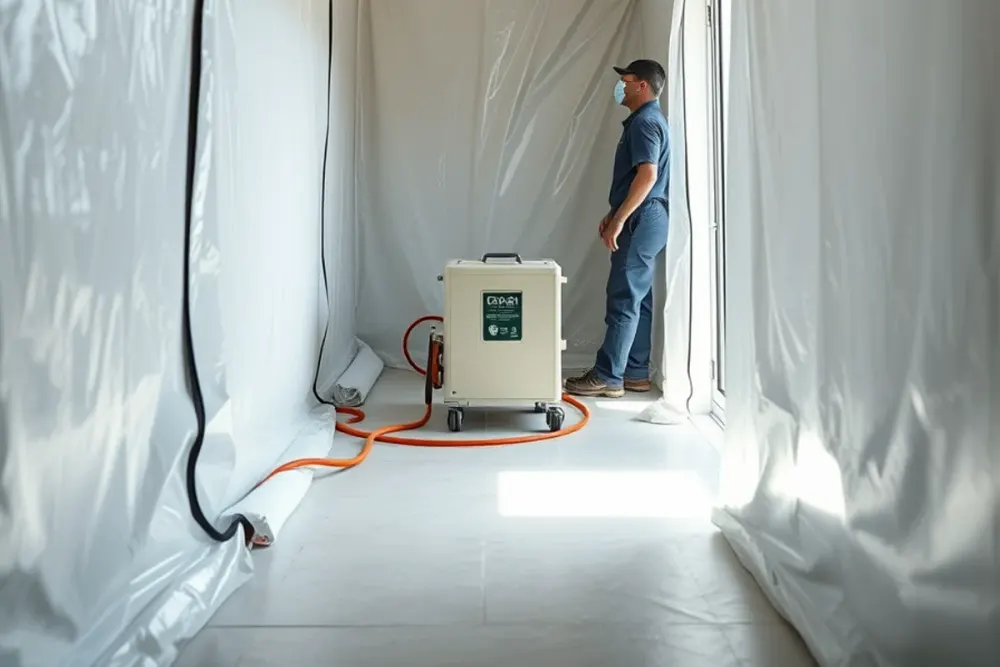
Plastic barriers with a zippered entry, negative air pressure and HEPA air scrubbing so spores released during removal are captured rather than migrating. HVAC serving the area is shut down and returns sealed.
Meters, thermal imaging and a physical inspection of the likely culprits — supply lines, drain connections, roof penetrations, slab leaks and HVAC condensate. We map both the growth and the water feeding it before scoping anything.
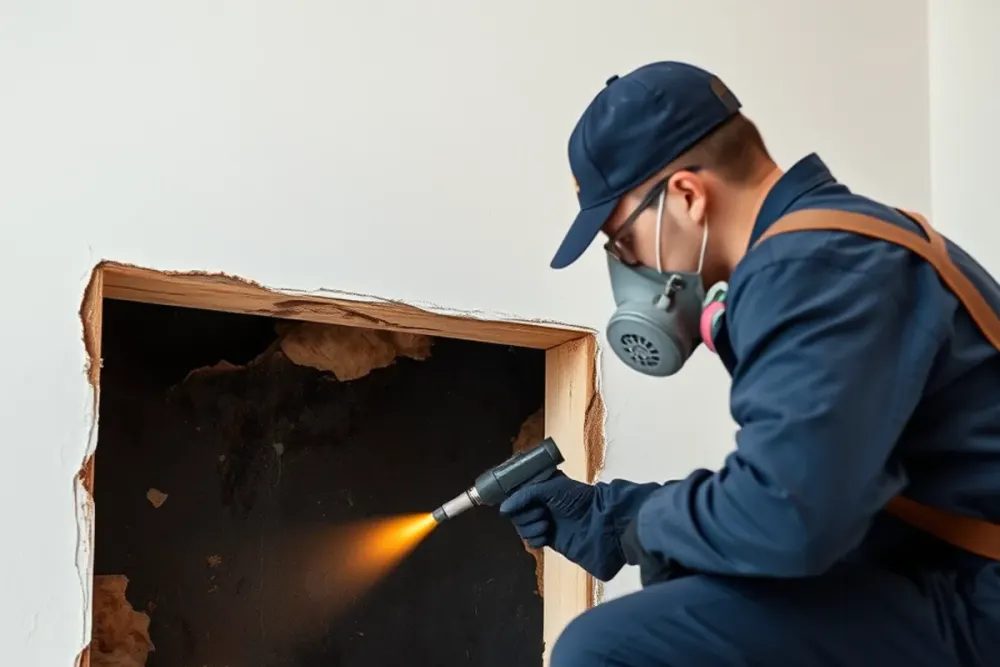
Affected porous material is cut out and bagged inside containment. Non-porous surfaces and structural framing are HEPA-vacuumed and detail-cleaned rather than removed wherever the material is sound.
The area is dried to a metered dry standard, adjacent surfaces and contents are cleaned so settled spores cannot re-colonize, and the work is verified before any rebuild begins.
For clearance testing we recommend an independent third-party assessor rather than testing our own work. A company grading its own homework is worth less to you than an independent result.
Containment first, source second, removal third. Any crew that starts cutting drywall before setting containment is about to contaminate the rest of your house.
Moisture meters, thermal imaging, and a physical inspection of the likely culprits — supply lines, drain connections, roof penetrations, slab leaks, HVAC condensate. We map both the growth and the water feeding it.
Visible growth is usually the smaller part. We establish how far it runs inside the assembly before we scope anything, so the removal line is set on evidence rather than optimism.
Sealed plastic barriers around the work area with negative air pressure and HEPA filtration, so spores released during removal are captured instead of migrating. HVAC serving the area gets shut down and returns sealed.
The leak gets repaired or the moisture condition corrected before remediation completes. We will not close a wall over an active leak — if the repair is a licensed plumbing or roofing scope, we coordinate it.
Affected porous material is cut out and bagged inside containment. Non-porous surfaces and structural framing are HEPA-vacuumed and cleaned rather than removed, wherever the material is sound.
HEPA air scrubbing continues through the job and after. Adjacent surfaces and contents get detail-cleaned so settled spores do not simply re-colonize the repaired area.
The area is dried to the metered dry standard, then visually and, where the situation warrants, independently verified before rebuild begins.
We find plenty of mold in houses that never flooded. In Downey it usually traces back to one of four slow, quiet moisture sources.
Slab leaks are the big one. A pinhole in a copper supply line under a 1960s slab releases water continuously, often for months, with no puddle ever appearing indoors. It migrates through the slab, wicks into the bottom plate of the wall, and grows mold from the inside out. The homeowner's first clue is frequently a smell or a warm spot on the floor, not water.
Second is the garage water heater. California requires water heaters to be strapped for seismic safety, and in Downey's aerospace-era tract homes they overwhelmingly sit in the garage. A slow tank seep against a garage wall goes unnoticed for a long time because nobody is looking at that corner.
Third is condensation from HVAC — a blocked condensate line backing up into a closet or ceiling cavity. Fourth is roof and flashing failure after a winter storm or a Santa Ana wind event: water enters at the penetration, tracks along the truss, and appears as a ceiling stain in a room nowhere near the actual breach. In every case the mold is a downstream symptom, and every one of them is fixable once found.
Stachybotrys chartarum — what people mean by black mold — is real, and it does grow on chronically wet cellulose materials like drywall paper. But color is not a reliable identifier. Plenty of harmless mold is black, and plenty of Stachybotrys looks dark green or gray.
Here is the practical position we take: the remediation approach does not change much based on species. Any significant indoor mold growth gets contained and removed the same way, because the process is driven by containment and moisture control rather than by which organism it is. Paying for species testing before remediation usually buys you a lab report, not a different scope of work.
Testing is genuinely useful in two situations. One, when there is a health complaint and a physician wants documentation. Two, as post-remediation verification — confirming the work succeeded. For that second case we recommend an independent third-party assessor rather than testing our own work, because a company grading its own homework is worth less to you than an independent clearance.
Mold pricing varies more than any other service we offer, because two jobs with identical visible growth can have entirely different scopes behind the wall.
Priced by square footage of contamination and how hard it is to reach. Growth inside a wall cavity, in a crawl space, or in an attic costs more per square foot than an accessible open wall.
A contained bathroom is straightforward. Multiple rooms, or a job requiring the household to work around containment for several days, needs more barrier material, more air machines, and more labor.
The remediation price does not include the plumbing or roofing repair that caused it. A slab leak repair is a real separate cost, and skipping it guarantees a repeat.
Removal leaves an open assembly. Putting back drywall, texture, paint, trim, and flooring is a separate line, and it is the part homeowners most often forget to budget for.
Mold is the symptom. Something in the house is wet, and until that changes everything else is temporary.
Encapsulating primer over active growth on wet material buys a few weeks. The mold keeps growing behind the paint and now it is hidden. If the repair is a licensed plumbing or roofing scope, we coordinate it rather than closing over it.
Slab leaks under the 1960s–70s tracts releasing water for months with no puddle. Garage water heaters seeping against the wall shared with a bedroom. Blocked HVAC condensate lines. Flashing that failed after a Santa Ana wind event. The mold is downstream of one of those.
If you can see growth and we can find the moisture, pre-remediation species testing usually buys a lab report rather than a different scope of work — the approach is driven by containment and moisture control. We will tell you when testing is genuinely worth paying for.
Colonization can start within 24 to 48 hours on wet cellulose material like drywall paper, and visible growth typically follows within a few days to a couple of weeks. This is exactly why we push so hard on same-day extraction and metered drying. A loss that is fully dried inside 48 hours very rarely becomes a mold job.
Usually not. If you can see growth and we can find the moisture source, testing before remediation mostly confirms what is already visible without changing the scope of work. Testing earns its keep as post-remediation verification, or when a doctor needs documentation for a health claim. In those cases we recommend an independent assessor rather than testing our own work.
It depends entirely on the cause. Mold resulting from a sudden covered loss — a burst pipe you reported promptly — is often covered, though many California policies cap mold at a specific sublimit like $5,000 or $10,000. Mold from a long-term leak, deferred maintenance, or humidity is generally excluded as gradual damage. Prompt reporting of the original water event is frequently the deciding factor.
No. Encapsulating primer over active growth on wet material buys a few weeks at best. The mold keeps growing on the back side of the paint, the moisture source is still feeding it, and now it is hidden from view. Encapsulants have a legitimate role on properly cleaned, dried, sound framing after remediation — but as a substitute for remediation they do not work.
It depends entirely on the cause. Mold resulting from a sudden covered loss you reported promptly is often covered, though many California policies cap it at a sublimit such as $5,000 or $10,000 regardless of your dwelling coverage. Mold from a long-term leak, deferred maintenance or humidity is generally excluded as gradual damage. Prompt reporting of the original water event is usually the deciding factor, which is why we push so hard on calling the day it happens.
The 24 to 48 hour figure gets quoted constantly and rarely explained. Here is what is actually happening, and what it means for your decisions.
Read article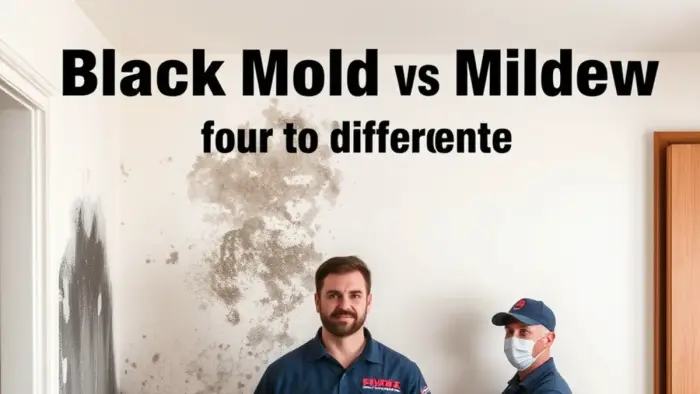
Color tells you almost nothing. What actually matters is whether it is on the surface or in the material — and whether something behind it is wet.
Read articleWe cover 43 areas from our base at 8615 Florence Ave. These are the ones we reach fastest:
We answer 24/7 and dispatch a crew within 60 minutes across Downey and the neighboring Gateway Cities. A person answers the phone — not an answering service.