
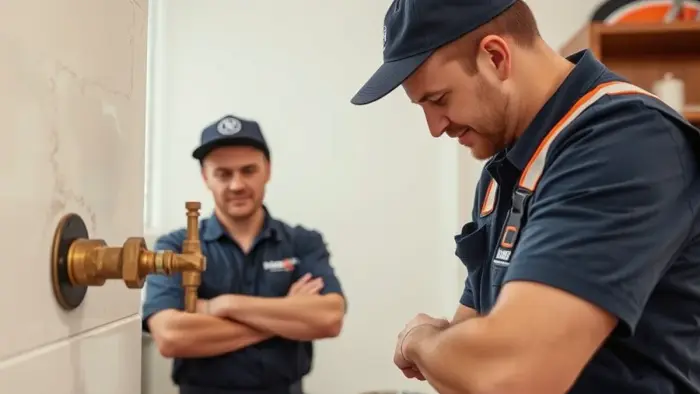
5 min read
How to Find and Shut Off Your Home's Main Water Valve (Before You Ever Need To)
The most valuable ten minutes of home maintenance there is — and the one thing we wish every caller had already done.
Read article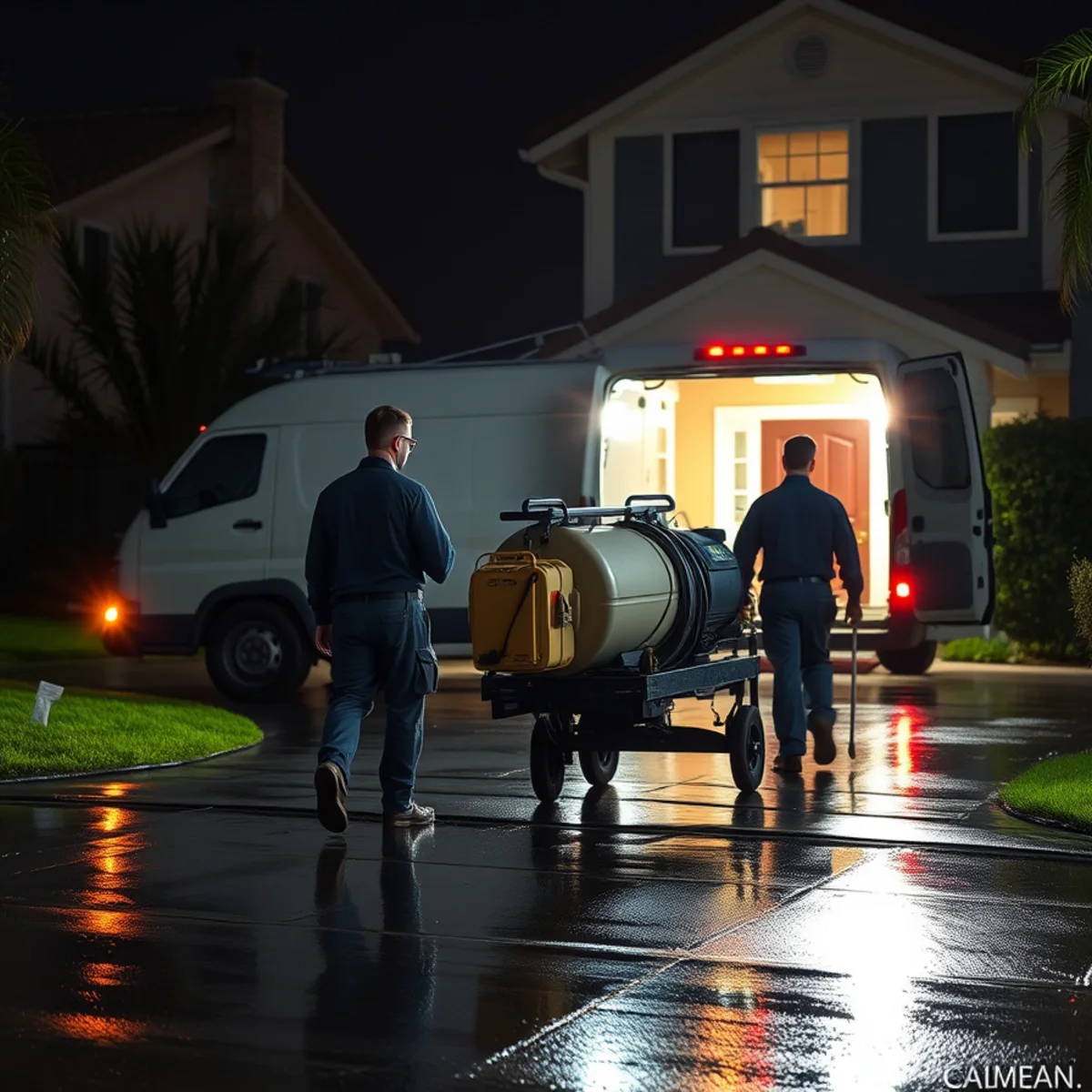
24/7 emergency service
If water is moving through your house right now, stop reading and call. The rest of this page will still be here.
Water emergencies do not schedule themselves for business hours. The supply line under the sink lets go at 2 a.m. The water heater fails while you are at work. The upstairs bathroom overflows on Thanksgiving morning. Damage does not pause overnight — it compounds. Water that sits from midnight until a nine o'clock callback has had nine hours to soak into the subfloor and start the mold clock.
So we staff for it. Our line is answered by a person, around the clock, and we dispatch a crew within 60 minutes across Downey and the neighboring Gateway Cities. Holidays included. From our base on Florence Ave, most of Downey is a 5 to 12 minute drive.
These situations get worse by the hour. None of them should wait until morning:
If water is near anything electrical, do not enter the room. Cut power at the breaker if the panel is safely reachable and dry — otherwise wait outside for the crew.
The emergency workflow is deliberately front-loaded — the most valuable minutes are the ones before we even arrive.
No voicemail box, no callback queue, no offshore call center reading a script. The dispatcher takes your address and the nature of the loss, then stays on the line.
You get walked through shutting off the main, killing power to affected circuits safely, and photographing the damage before anything moves. That first-hour documentation carries real weight with an adjuster.
Truck-mounted extraction, drying equipment, moisture meters and thermal imaging arrive together. We do not turn up to assess and then leave to fetch equipment.
Bulk water removal begins on the same visit, always. Air movers and dehumidifiers are running when the first visit ends so the structure dries overnight rather than sitting wet until a daytime crew arrives.
There is no scenario where we look at an active loss and book you for tomorrow.
The emergency workflow is deliberately front-loaded. The most valuable minutes are the ones before we even arrive, so we start coaching you through them on the phone.
You reach a human who takes your address, the nature of the loss, and whether anyone is at risk. No voicemail, no callback queue, no offshore answering service reading a script.
The dispatcher stays with you and walks you through shutting off the main, killing power to affected circuits, and photographing the damage. That first-hour documentation carries real weight with your adjuster.
A truck-mounted extraction unit, drying equipment, moisture meters, and thermal imaging come on the first trip. We do not arrive to assess and then leave to fetch equipment.
Safety check, then source identification, then water category, then a moisture map of the real wet perimeter. You get told what we found and what we are about to do before we do it.
Bulk water removal begins during the same visit — always. There is no scenario where we look at an active loss and book you for tomorrow.
Air movers and dehumidifiers are running when the first visit ends, so the structure is drying overnight rather than sitting wet until a daytime crew arrives.
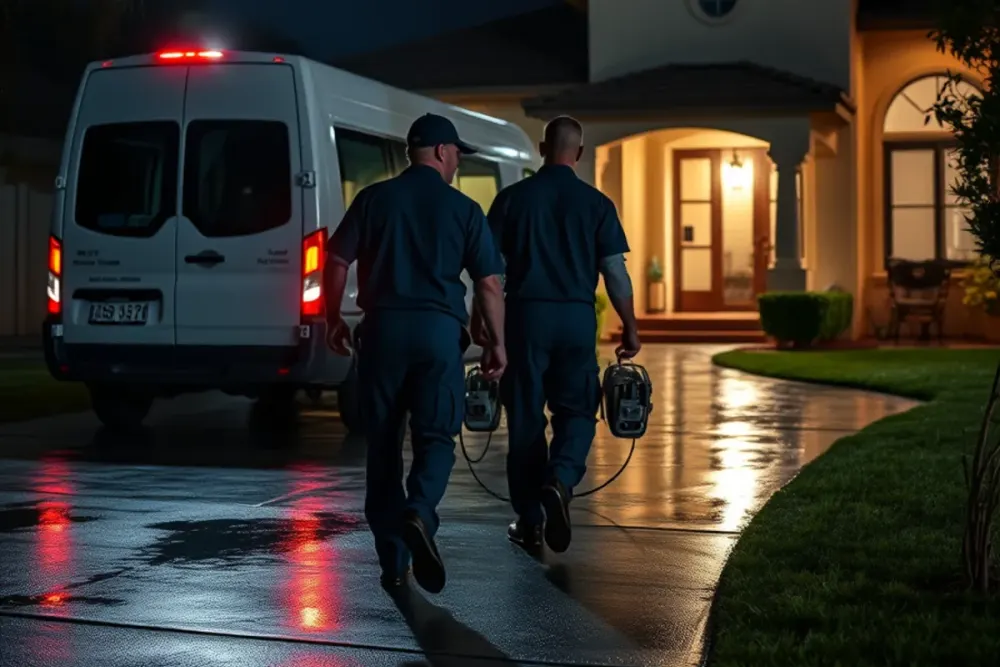
While the crew is en route, a few actions genuinely change the outcome. Do only the ones that are safe.
In priority order:
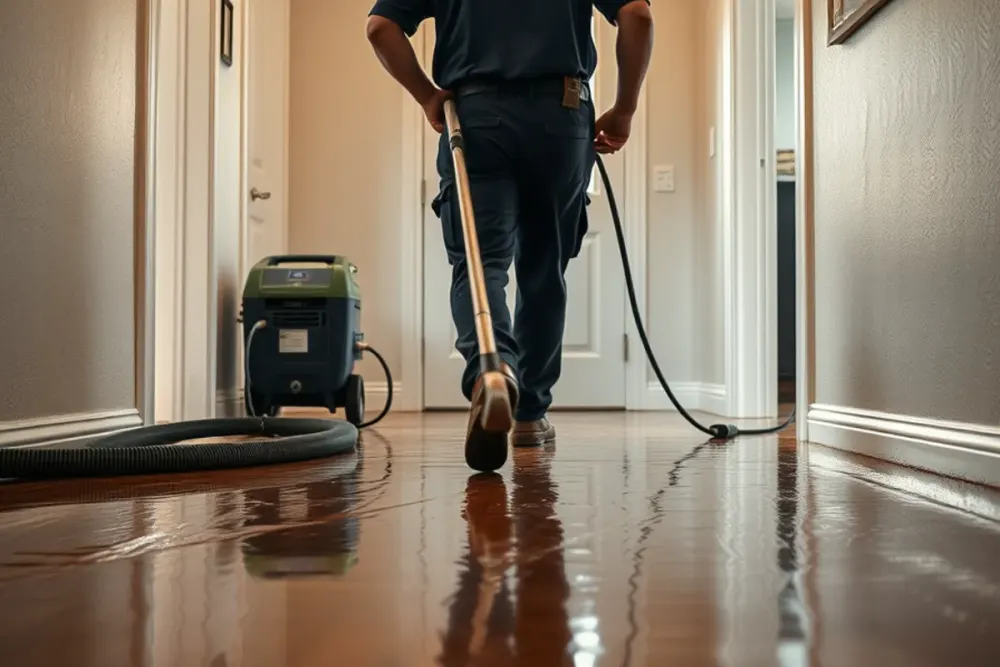
There is a real reason we push so hard on after-hours response, and it is not the callout fee.
Water damage does not progress in a straight line — it accelerates. In the first hour it is surface water sitting on flooring. By hour four it has wicked several inches up drywall and saturated the pad. By hour eight it is in the subfloor and the bottom plate of the wall. Past twenty-four hours, on wet cellulose in a warm house, mold begins colonizing. Each of those thresholds moves the job into a more expensive category, and the overnight gap is exactly long enough to cross two of them.
This is why a company that answers at 2 a.m. is worth more than one with a slightly lower hourly rate that starts at eight. The eight-hour delay routinely costs more than the entire difference in labor rate — and it is the difference between drying your floor and replacing it.
Straight answer: after-hours mobilization carries a callout component, and here is how it actually nets out.
Nights, weekends, and holidays carry an emergency dispatch cost — crews are being called in outside normal hours. We tell you this on the phone rather than letting it show up on an invoice.
Because the loss stops growing. Waiting until morning routinely adds subfloor damage, more drywall removal, and a mold risk that dwarfs the callout difference.
Policies impose a duty to mitigate — to take reasonable steps to prevent further damage. Emergency mitigation is normally covered, and delaying can give a carrier grounds to reduce a claim.
As with any loss, affected square footage, water category, and materials move the number far more than the hour of the call does.
Water damage accelerates through thresholds, and the overnight gap is exactly long enough to cross two of them.
Hour one is surface water on flooring. By hour four it has wicked inches up drywall and saturated the pad. By hour eight it is in the subfloor and the bottom plate. Past 24 hours mold begins colonizing. An eight-hour delay routinely costs more than any difference in hourly rate.
Nights, weekends and holidays. From our Florence Ave base most of Downey is five to twelve minutes, so crews are usually working well inside that window.
Policies impose a duty to take reasonable steps to prevent further damage. Emergency mitigation is normally covered, and delaying it can give a carrier grounds to reduce a claim.
Yes, and a person picks up — not a voicemail box and not an offshore call center. The dispatcher takes your details, stays on the line to walk you through shutting off water and cutting power safely, and gets the crew moving while you are still talking.
We dispatch within 60 minutes across Downey and the neighboring Gateway Cities. From our Florence Ave base most of Downey is a 5 to 12 minute drive, so crews usually arrive well inside that window. During a major storm when call volume spikes, we will give you an honest arrival time rather than a number we cannot hit.
Shut off the water at the main if the source is a supply line or appliance. Cut power to the affected area only if the panel is dry and safely reachable. Photograph everything before moving anything. Call your insurer to open the claim. Lift valuables off the floor. Do not run a shop vac or box fans on contaminated water. The dispatcher will walk you through all of it on the call.
We document the loss from the first hour — pre-mitigation photos, moisture maps, daily drying logs, and an itemized scope — which is exactly the evidence adjusters want. We coordinate directly with all major carriers and can meet your adjuster on site. We are not public adjusters and do not negotiate the settlement, but thorough documentation is what prevents most disputes from starting.
Call and stay on the line — the dispatcher will talk you to it. In most Downey homes the main is on the street-facing side near the hose bib, or in the meter box at the sidewalk; turn it clockwise. If it is an old gate valve that has seized, do not force it hard enough to snap the stem. Go to the meter box valve instead, and if that fails the crew handles it on arrival.
The most valuable ten minutes of home maintenance there is — and the one thing we wish every caller had already done.
Read article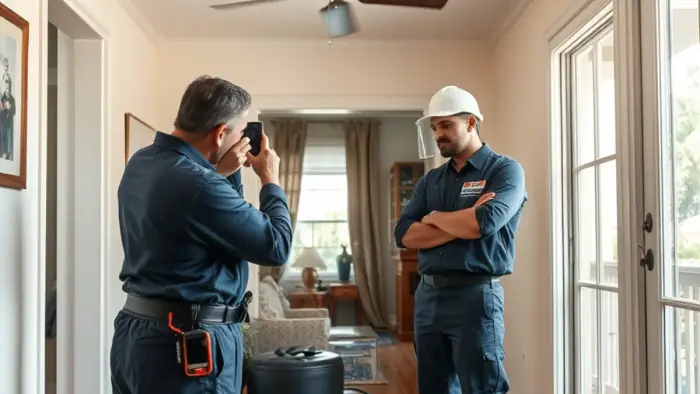
The most valuable photographs of the entire claim are the ones taken before anyone touches anything. That window closes in about an hour.
Read articleWe cover 43 areas from our base at 8615 Florence Ave. These are the ones we reach fastest:
We answer 24/7 and dispatch a crew within 60 minutes across Downey and the neighboring Gateway Cities. A person answers the phone — not an answering service.