Emergency Guides
How to Find and Shut Off Your Home's Main Water Valve
The most valuable ten minutes of home maintenance there is — and the one thing we wish every caller had already done.
The short answer
In most Downey homes the main shut-off is on the street-facing side of the house near the hose bib, or in the meter box at the sidewalk. Turn a round handle clockwise, or a lever a quarter turn to perpendicular. Find it and test it now — old gate valves seize, and discovering that during an emergency is far worse.
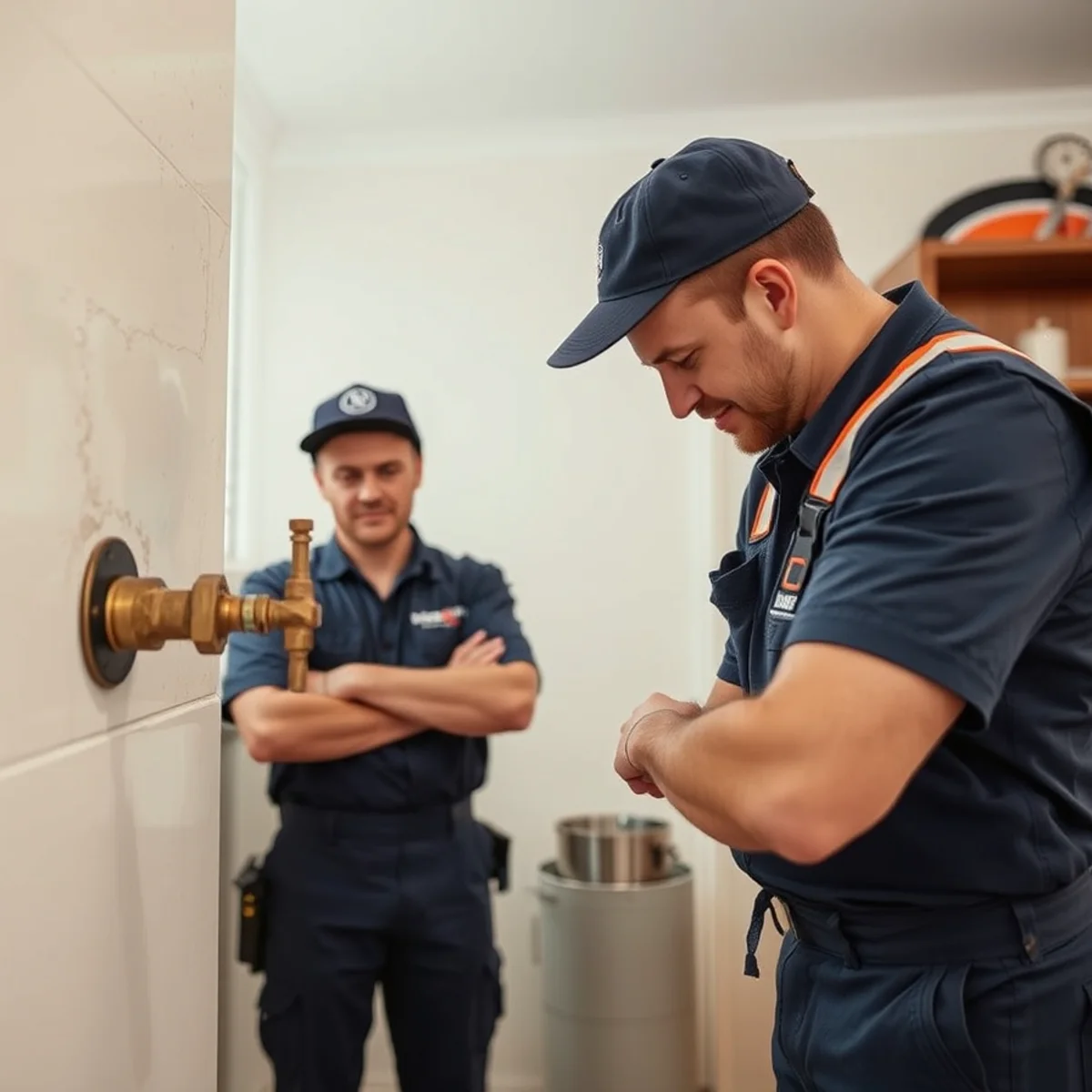
Every emergency call we take starts the same way. We ask whether the water is off. A meaningful number of people do not know where the valve is, and we end up talking them around the outside of their own house at two in the morning while it keeps running.
Ten minutes on a Saturday fixes that permanently. Here is how.
Where it is in a typical Downey home
There are usually two options, and it is worth knowing both.
The house-side valve is most often on the street-facing side of the house, at or near ground level, frequently within a few feet of an outdoor hose bib. Look for a valve on the pipe where the supply enters the building. In homes with the water heater in the garage — which is most of Downey's post-war and tract housing — it is sometimes in the garage near the heater instead.
The meter valve is in the meter box at the sidewalk or in the parkway: a rectangular concrete or plastic lid, usually marked WATER. Lift it and you will find the meter and a valve on the house side of it. This one always exists, which is why it is worth knowing about — it is your backup when the house valve fails.
How to turn it off
- Round handle (gate valve): turn clockwise until it stops. It may take several full rotations.
- Lever handle (ball valve): a quarter turn, until the lever sits perpendicular to the pipe.
- Meter box valve: often needs a meter key or a large adjustable wrench. A quarter turn to perpendicular closes it.
Buy a meter key
They cost very little at any hardware store and they are the difference between reaching the meter valve and not. An adjustable wrench works on many valves but not all, and lying on a sidewalk at night improvising with the wrong tool is a bad plan.
Keep it somewhere obvious. Taped inside the meter box lid is a popular choice and works well.
Know the other shut-offs too
The main is the nuclear option. For most emergencies there is a closer valve that isolates only the problem, which means the rest of the house keeps working.
| Fixture or appliance | Where the local shut-off is |
|---|---|
| Toilet | Angle stop on the wall behind it at floor level — oval or football-shaped handle |
| Sink | Two angle stops under the basin, hot and cold |
| Washing machine | Two valves on the wall behind the machine |
| Water heater | Valve on the cold inlet pipe at the top of the tank |
| Dishwasher | Usually under the adjacent sink, on a dedicated branch off the hot supply |
| Refrigerator ice maker | Small saddle or angle valve behind the fridge, or under the nearest sink |
Then tell everyone in the house
This is the step that gets skipped. The person who knows where the valve is will not always be the person who is home when a pipe fails.
Walk everyone out to it once. Photograph it and put the photo in a shared album or a note on the fridge. If you have older children, teenagers, or a family member who stays with you, they should know too. Same applies if you rent out property — put it in the welcome pack with a photo.
Why this matters more in older Downey homes
If your house dates from the 1940s or 50s, the pipes are on a clock. Galvanized steel has a design life around fifty years and that stock is at seventy to eighty — so the question is when, not whether.
The same age applies to the shut-off valve itself. A gate valve that has sat untouched since 1952 is exactly the one that will not turn when you need it. Test yours this weekend, and if it resists, replace it before the pipes force the issue.
At six to eight gallons a minute from a burst supply line, the difference between finding the valve in one minute and finding it in fifteen is about a hundred gallons of water inside your house.
Frequently asked
Do not force it hard enough to snap the stem — that turns a burst pipe into one you cannot stop at all. Go to the meter box at the sidewalk and use the valve there instead. Then get the house valve replaced by a plumber as a scheduled job. A seized main is a genuine emergency risk in any home with aging plumbing.
Yes, and it is one of the highest-value habits there is. Most catastrophic floods we attend happened in empty houses, where a failure ran for hours or days. Closing the main takes thirty seconds. If you have an irrigation system on a separate line, that continues to work, and if you have a tankless heater or specific appliances with requirements, check those first.
It is worth the few dollars. Many meter box valves need one, and an adjustable wrench does not fit every type. Buy one, tape it inside the meter box lid, and you will never be improvising with the wrong tool on a sidewalk at night.
Ten minutes now, or fifteen at 2 a.m.
At six to eight gallons a minute from a burst supply line, the difference between finding the valve in one minute and finding it in fifteen is roughly a hundred gallons inside your house.
Test it rather than just locating it. A gate valve that has sat untouched since 1952 is exactly the one that will not turn when it matters, and replacing it is a scheduled plumbing job rather than an emergency.
Then tell everyone in the house, photograph it, and buy a meter key for the sidewalk valve. The person who knows where the valve is will not always be the person who is home when a pipe fails.
Services mentioned in this article
24/7 Emergency Water Removal
A person answers, 24/7. Crews dispatched within 60 minutes — nights, weekends, and holidays included.
Learn moreBurst Pipe Cleanup
Shut-off guidance on the phone, extraction on arrival, and the wall cavity dried properly — not just the carpet.
Learn moreLeak Detection & Repair Coordination
Acoustic, thermal, and pressure testing that pinpoints the leak — so the repair opens one small area, not the whole floor.
Learn moreAreas covered in this article
Historic core along Firestone Blvd and Old River School Rd — 1920s–40s commercial buildings and pre-1960 homes with…
about 6 minutes from our Florence Ave baseNorth Downey1940s–50s post-war bungalow belt — the highest concentration of pre-1960 homes in Downey, and the oldest galvanized…
3 to 7 minutes from our Florence Ave base