Emergency Guides
Dishwasher Leaked Overnight and Flooded the Kitchen — Now What?
The floor is the easy part. What happens under the cabinets and into the subfloor is what turns this into a kitchen renovation.
The short answer
Turn the dishwasher off at the breaker and close its supply valve, usually under the adjacent sink. Then look past the visible floor: water runs into the recess under the machine and along the toe-kick void beneath the whole cabinet run, where there is no airflow and it will not dry on its own.
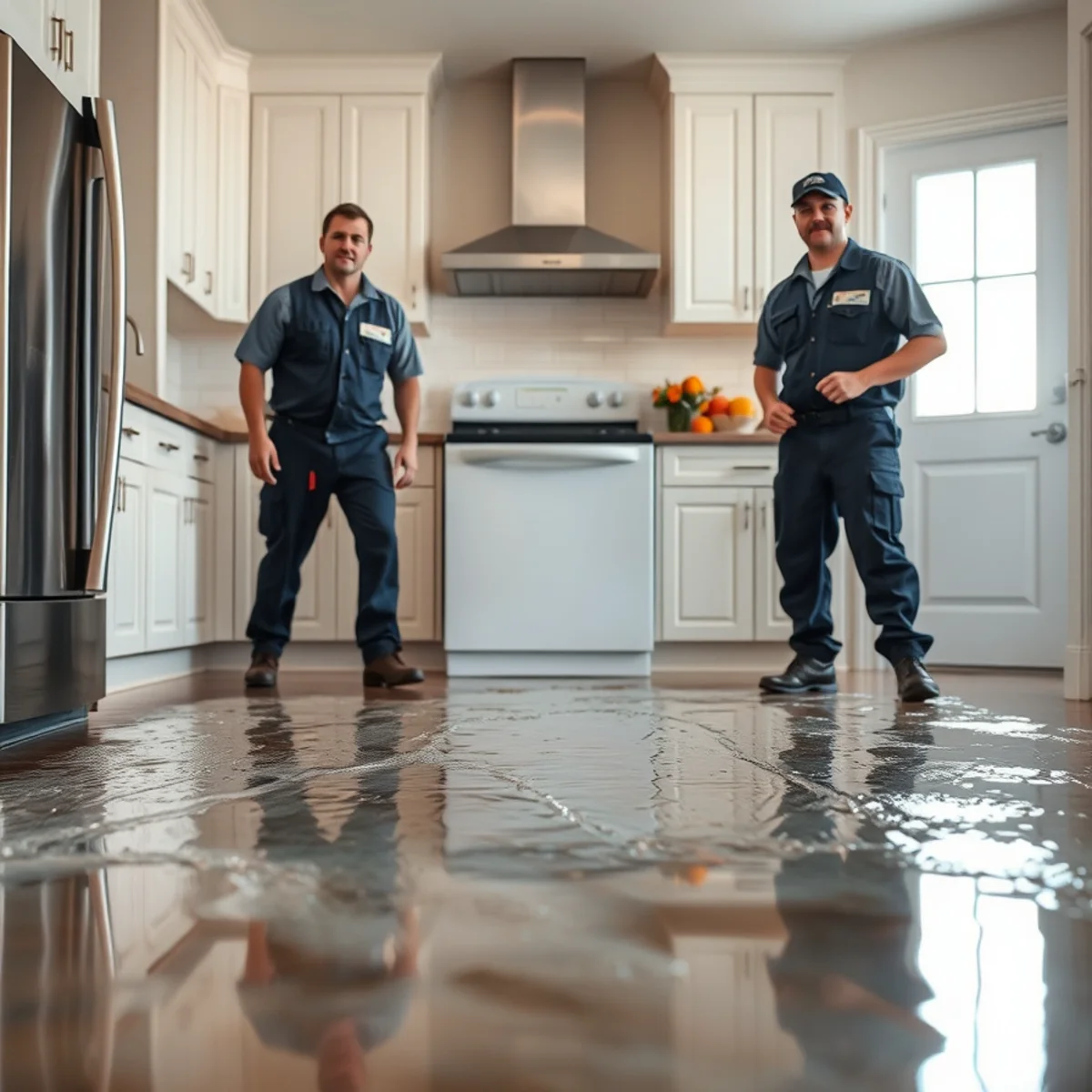
Kitchen floods have a particular cruelty to them: the visible water is trivial to deal with, and the water you cannot see is expensive.
A dishwasher sits recessed under a countertop, surrounded by cabinetry, with its own cavity underneath. When it leaks, water goes into that cavity first, then travels along the subfloor beneath the cabinet run in both directions. By the time it appears on your kitchen floor, it has usually been spreading underneath for a while.
First: stop the water and the machine
- Turn the dishwasher off at the wall or pull its breaker — do not open the door mid-cycle unless the machine has stopped
- Close the dishwasher supply valve, which is usually under the adjacent sink on a dedicated branch off the hot supply
- If you cannot find it, close both angle stops under the sink, or the main
- Cut power to the kitchen circuits if water has reached outlets or the base of appliances
Then: work out where it actually went
This is the part that decides the cost of the job, and it is where a lot of kitchen losses get underestimated.
- Under the dishwasher itself — the recess it sits in has no airflow and drains nowhere
- Into the toe-kick void beneath the adjacent base cabinets, which runs continuously along the cabinet line
- Under the cabinet floor panels, which are usually particle board and act as a wick
- Along the subfloor beneath the flooring, in whichever direction the floor falls
- Through to the room behind, if the kitchen shares a wall with living space
- Down into the ceiling below, if the kitchen is on an upper floor
What we do differently in a kitchen
Standard room drying does very little for a kitchen, because the wet parts are inside sealed voids with no air exchange. Pointing an air mover at the middle of the floor dries the tile and nothing else.
So we open the cavities deliberately. Toe-kick panels come off — they are designed to be removable and can usually be refitted — which gives direct access to the void under the entire cabinet run. Where needed we drill small controlled access points to get airflow into individual cabinet bases. Then air movers and dehumidifiers work those cavities directly rather than the room around them.
The dishwasher itself gets pulled out. There is no way to dry the recess it sits in with the machine in place, and that recess is usually the wettest point in the room.
What usually survives, and what does not
| Component | Typical outcome |
|---|---|
| Solid wood cabinet doors and face frames | Usually saved with prompt drying |
| Particle board cabinet boxes and toe-kicks | Frequently need replacement once swollen |
| Tile or stone flooring over slab | Usually fine; the slab underneath needs drying |
| Engineered or laminate flooring | Often lost — water gets between layers and delaminates them |
| Solid hardwood | Salvageable if caught within about 24 hours with drying panels |
| Drywall at the base of walls | Dried in place for clean water; removed if contaminated or badly saturated |
The overnight problem
A dishwasher that leaks during a cycle while everyone is asleep, or during the working day in an empty house, is running unattended for six to ten hours. That is long enough for water to reach every cabinet in the run and to saturate subfloor well beyond the kitchen.
It is also past the point where Category 1 clean water starts degrading, and comfortably inside the window where mold begins colonizing wet particle board — which is about as good a growth medium as exists in a house.
Preventing the next one
- Replace the dishwasher supply line when you replace the machine, not never — braided stainless, and note the date
- Check the door gasket periodically; a perished gasket causes slow leaks that soak the floor in front of the machine
- Look under the sink for damp at the dishwasher drain connection, a common slow-leak point
- Do not run the dishwasher when leaving the house or going to bed if you can avoid it — the overnight run is what turns a small failure into a large one
- A leak sensor placed in the toe-kick void under the sink cabinet costs very little and catches this early
If your kitchen floods and you want it looked at properly, our line is answered 24/7 and we dispatch within 60 minutes across Downey and the neighboring Gateway Cities.
Frequently asked
Often partly. Solid wood doors and face frames usually survive with prompt drying. Particle board cabinet boxes and toe-kicks frequently do not once they have swollen — the material loses structural integrity irreversibly. Fast access to the cavity underneath is what decides it, which means pulling toe-kicks off and drying the void rather than the room.
Yes. In a kitchen the visible floor is the least informative surface in the room. The recess under the dishwasher, the toe-kick void running along the cabinet line, and the subfloor beneath the flooring have no airflow and do not dry on their own. Establishing whether they are wet takes a moisture meter, and it is a ten-minute check.
Longer than a comparable bedroom, typically five to seven days rather than three to five, because the wet material is inside sealed cavities that have to be opened and dried directly. If solid hardwood is involved it can run considerably longer, since wood is metered separately and released only when the boards reach the dry standard.
The floor is the easy part
Kitchen floods are expensive because the wet parts are inside sealed voids. Pointing an air mover at the middle of the room dries the tile and nothing else.
Toe-kick panels come off — they are designed to be removable — and the dishwasher gets pulled so the recess it sits in can be dried. Particle board cabinet carcasses swell irreversibly once wet, while solid wood doors and face frames usually survive, so speed decides how much of the kitchen you keep.
The overnight run is what turns a small failure into a large one. If you can avoid starting a cycle when leaving the house or going to bed, do — and put a leak sensor in the toe-kick void under the sink cabinet.
Services mentioned in this article
Water Extraction & Removal
Truck-mounted extractors pull standing water out in a single pass — the fastest way to stop damage from spreading downward.
Learn moreStructural Drying & Dehumidification
Metered, monitored drying that takes the structure back to its dry standard — not just the surface you can touch.
Learn moreResidential Water Damage Restoration
One team from the first extraction to the last coat of paint — no handing you off to three other contractors.
Learn moreAreas covered in this article
1990s–2000s mixed-use retail and residential development on the former NASA/Rockwell site — newer construction, but…
about 9 minutes from our Florence Ave baseBrookshire / GallatinA 1950s–60s residential pocket that sits within about five minutes of our 8615 Florence Ave base — our fastest resp…
about 5 minutes from our Florence Ave base