How Much Does Water Damage Restoration Cost in Downey? (2026 Price Guide)
Published research puts the national average near $3,867. Here is what actually moves your number, and why the phone quote you were given is probably wrong.
Read article
Specialist restoration
Most homeowners discover the real problem with water damage about two weeks in. The emergency crew dried the house, packed up, and left — and now you are trying to find a drywall contractor, a flooring installer, and a painter, while your adjuster asks for a scope none of them will write.
That gap is where restoration jobs stall for months. It is also entirely avoidable.
We handle residential losses end to end: the emergency extraction, the metered drying, the demolition, and the rebuild through to the final coat of paint. One scope, one schedule, one point of contact, and one set of documentation that goes to your adjuster. You should be dealing with your family and your insurer, not coordinating trades.
Every residential loss we take runs through the same process, whatever started it:
Whatever the source, the sequence is the same: stop the water, extract, dry to a metered standard, remove what cannot be saved, then rebuild.
One scope, one schedule, one point of contact for your adjuster — from the first gallon extracted to the last coat of paint.
Extraction, containment where the water category requires it, and drying equipment placed on the first visit. This is where the loss stops growing.
A dry standard set from unaffected material in your own home, daily readings at marked points, and equipment adjusted on the numbers. Typically three to five days, longer for plaster or slab.
Drywall, insulation, flooring, baseboards, cabinetry, texture matched to the existing finish and paint. This is the phase most emergency-only companies hand off, and where jobs stall for months when nobody owns it.
Pre-mitigation photographs, the moisture map, daily drying logs, an itemized scope and an on-site walkthrough with your adjuster.
You should be dealing with your family and your insurer, not coordinating three trades and chasing a scope none of them will write.
Eight phases, following the IICRC S500 standard. Most Downey homes are through the mitigation phases in three to five days; the rebuild depends on scope.
We identify the water source, determine the category and class, and map hidden moisture with meters and thermal imaging. You get the scope and the plan explained before work starts.
Truck-mounted extractors and submersible pumps remove standing water and pull it out of carpet, pad, and assemblies. This begins on the first visit, always.
Air movers and dehumidifiers sized to the space and the class of loss, running until metered readings reach the dry standard. Typically three to five days.
Affected surfaces cleaned and disinfected, with HEPA air scrubbing throughout. Category 2 and 3 losses get the full antimicrobial protocol.
If growth is present or the loss sat long enough to make it likely, containment goes up and remediation is done properly rather than hoping drying was enough.
Drywall, insulation, flooring, baseboards, cabinetry, and paint. Texture matched to the existing finish. This is the phase most emergency-only companies hand off.
Daily moisture readings, photographs, and an itemized scope compiled into a claim file, from the first hour through completion.
We walk the completed work with you, confirm the readings are back to normal, and hand over the full documentation package.

Working the same city for long enough teaches you what to check before you are asked. Downey's housing divides into a few distinct eras, and each fails in its own way.
The 1940s–50s post-war bungalows — North Downey, the Woodruff/Florence corridor, Studebaker/Firestone — are raised-foundation homes with original galvanized supply lines and clay-tile sewer laterals. Here we check the crawl space early, because that is where the water goes and nobody looks. Rusty water and declining pressure mean the supply system is at the end of its life.
The 1960s–70s tracts — South Downey, Apollo, the Warren High subdivisions — are slab-on-grade with copper underneath, and this is slab leak country. On these we meter the floor and the wall bases carefully, because moisture arrives from below rather than above.
The 1990s–2000s townhomes and shared-wall developments around Downey Landing have newer plumbing but a different vulnerability: water migrates horizontally between units through shared walls and shared stacks. On these we always check the neighboring unit, and we tell the owner to notify their HOA early because those claims involve more than one policy.
And across all of them, the garage water heater. Downey puts them in the garage almost universally, and the wall shared with the living space is wet more often than not by the time we arrive.

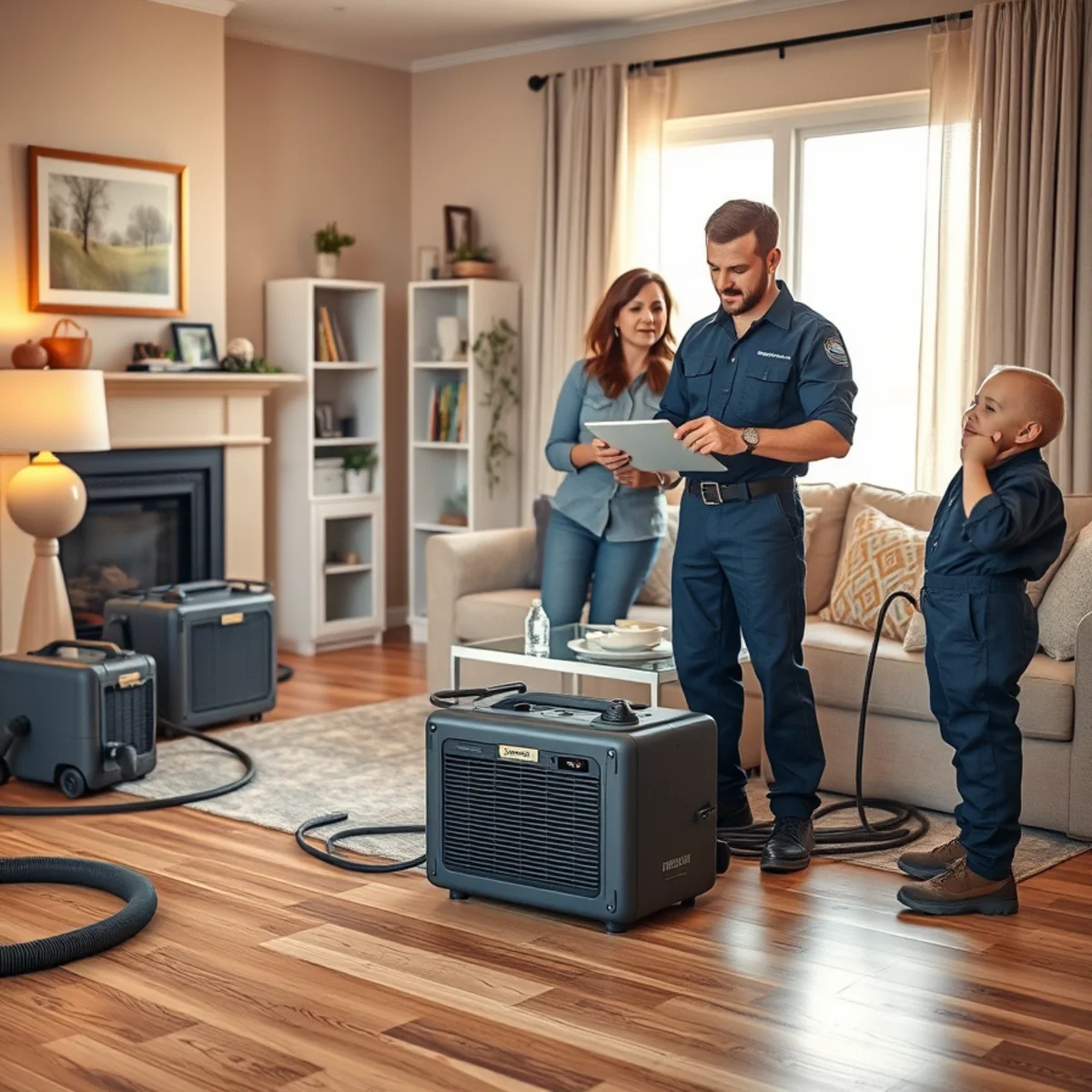
We are a restoration contractor, not a public adjuster. We do not negotiate your settlement, and anyone who promises to get your claim approved is telling you something they cannot control.
What we do is remove the reasons claims get reduced. Documentation from the first hour, before mitigation — the photographs adjusters weight most heavily. A moisture map showing the real affected area rather than the visible one. Daily drying logs with readings, humidity, and temperature. An itemized scope in the format carriers expect. And we will meet your adjuster on site to walk the loss together, which resolves more disagreements than any amount of paperwork.
Three things you should do yourself, and they matter. Report the loss to your carrier within 24 hours — most policies require prompt notification and delayed reporting is a legitimate basis for denial. Keep an itemized list of damaged personal property with replacement values, because contents claims are settled from your list, not ours. And keep receipts for anything you spend during the loss, including the increase in your electricity bill while drying equipment runs, since that is frequently reimbursable.
We do not quote over the phone, because an honest number needs a moisture map. What we can give you is the national research range and a clear view of what moves it — and a free on-site estimate before any work is authorized.
Industry research puts the national average water damage restoration cost around $3,867, with a typical range of roughly $1,384 to $6,384. Mitigation commonly runs about $3 to $7.50 per square foot and repair or rebuild about $20 to $37 per square foot. These are national figures for orientation, not a quote, and Southern California labor and materials differ.
Clean water over a small area is the low end. Category 3 contamination across multiple rooms is the high end, because of containment, protective equipment, material removal, and regulated disposal.
The largest controllable factor by far. Same-day mitigation often keeps a loss in the extraction-and-dry category. A loss left over a weekend commonly adds demolition, rebuild, and mold remediation.
Drywall and paint are predictable. Matching a discontinued tile, restoring hardwood, or rebuilding custom cabinetry moves the number substantially — which is why the estimate happens on site, not on the phone.
Working the same city long enough teaches you what to check before you are asked.
North Downey, the Woodruff/Florence corridor and Studebaker/Firestone are raised-foundation homes with galvanized supply and clay-tile laterals. A leak drains under the house where nobody looks, so that is where we start.
South Downey, Apollo and the Warren High subdivisions are slab-on-grade with copper underneath. Moisture arrives from below rather than above, so the diagnostic is completely different.
Around Downey Landing water migrates horizontally between units through party walls and shared stacks. We ask to meter the adjacent unit, and it is wet more often than owners expect.
Both, and that is the main reason people choose us. Many companies dry the house and leave you to find a drywall contractor, a flooring installer, and a painter yourself — which is exactly where jobs stall for months. We carry it from the first extraction through the final coat of paint, with one scope, one schedule, and one point of contact for your adjuster.
We will not invent a number over the phone, because an accurate figure needs a moisture map and an on-site look. For context, national research puts the average around $3,867 with a typical range of roughly $1,384 to $6,384, mitigation around $3 to $7.50 per square foot, and rebuild around $20 to $37 per square foot. Those are national orientation figures. Your estimate is free, on site, and itemized before any work is authorized.
Often not at all. Most clean-water losses let you stay, though the affected rooms are noisy and off-limits for three to five days while equipment runs. Category 3 sewage losses, jobs affecting a kitchen or the only bathroom, and significant mold remediation are the cases where we recommend staying elsewhere. Additional living expenses are frequently covered by the policy — ask your adjuster rather than assuming you would be paying.
You choose. In California you have the right to select your own contractor. Carriers maintain preferred vendor programs and will often recommend one, and those companies can be perfectly good — but you are not obliged to use them, and the recommendation does not change your coverage. Pick the contractor you want and tell your adjuster who is doing the work.
Anything standing on wet flooring comes up first — blocked, foiled, or moved out of the room — because furniture legs stain carpet and trap moisture underneath. Items already saturated are separated and inventoried for your claim rather than quietly discarded. If a room has to be cleared completely we tell you before anything moves, and we photograph the contents as they were so nothing is disputed later.

Published research puts the national average near $3,867. Here is what actually moves your number, and why the phone quote you were given is probably wrong.
Read article
One phrase decides most water damage claims in California: sudden and accidental. Here is what falls either side of it.
Read articleWe cover 43 areas from our base at 8615 Florence Ave. These are the ones we reach fastest:
We answer 24/7 and dispatch a crew within 60 minutes across Downey and the neighboring Gateway Cities. A person answers the phone — not an answering service.