
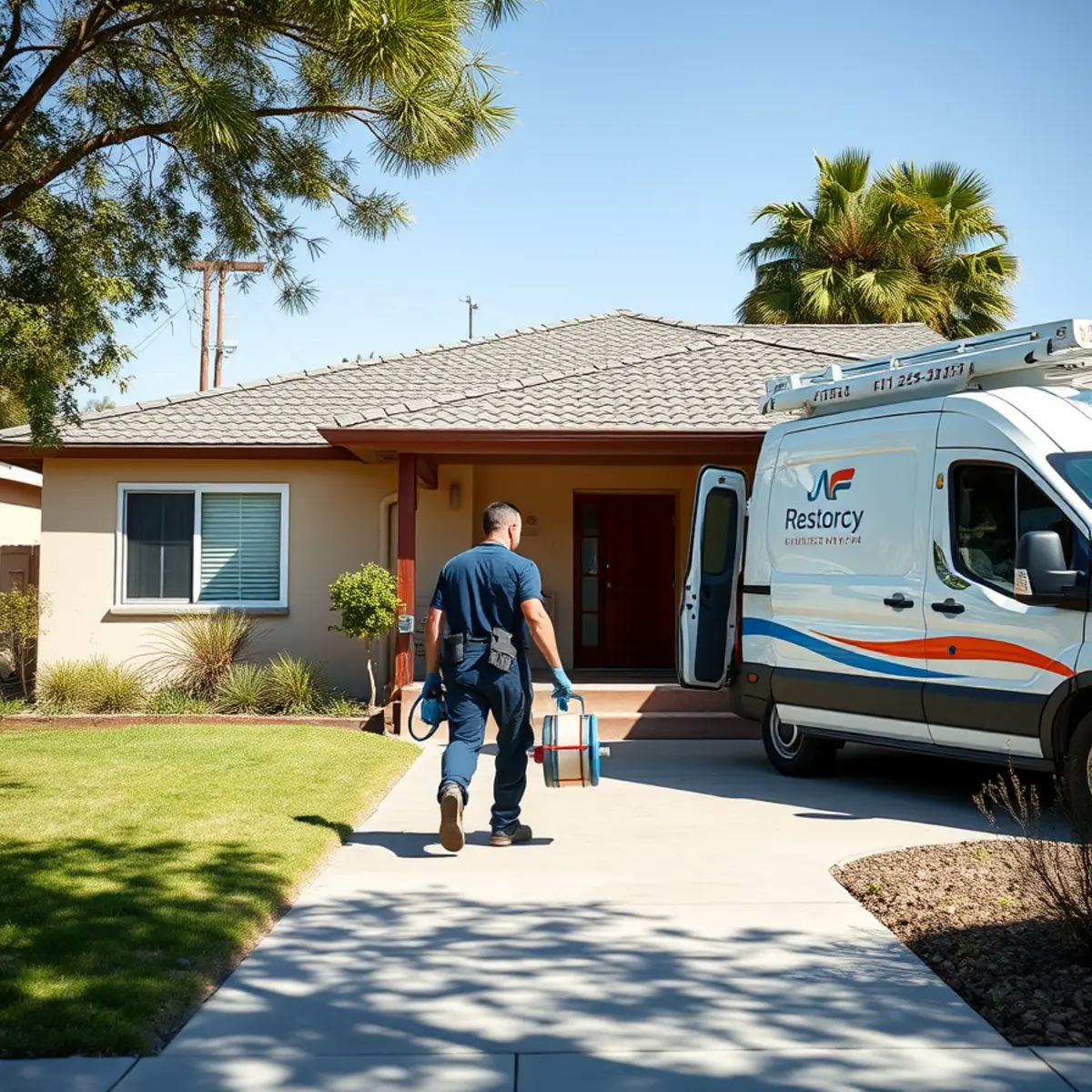
Core service area
Water Damage Restoration in Lakewood, CA
Lakewood is a genuinely remarkable piece of American housing history. Built between 1950 and 1953 on former farmland, it went up at a pace that made national news — one of the largest planned communities in the country, roughly 17,500 homes, with construction methods that turned housebuilding into assembly-line work.
- Open 24/7
- 60-minute emergency dispatch
- about 15 minutes from our Downey base
- IICRC S500 standard
That history has a direct consequence for us seventy years later. When you build 17,500 houses in three years with the same materials and the same crews, their plumbing systems reach the end of their service life at the same time.
We see the result as a steady, city-wide stream of slab leaks. We are about fifteen minutes away.
An Entire City's Plumbing on One Clock
These are slab-on-grade homes with copper supply lines run under the concrete — the standard for the period, and a construction method that is efficient to build and difficult to service.
Under-slab copper in this basin faces three simultaneous attacks. Expansive clay soil swells with winter rain and shrinks through summer, flexing the pipe. Water chemistry drives pinhole corrosion from the inside. And thermal cycling makes hot lines expand and contract against the concrete they pass through, abrading them a fraction more with every use. Seventy years of that produces holes.
What makes Lakewood distinctive is the synchronization. In a city that filled in gradually, failures spread across decades. Here, an entire neighborhood's plumbing is the same age, and we see the clustering directly — runs of slab leak calls from the same tract within a year or two of each other.
The other consequence of the construction method is uniformity of layout. Once you have worked a few of these houses, you know where the lines run, which speeds up detection considerably.
Lakewood work, overwhelmingly:
- Slab leaks in original copper under 1950s foundations
- Repeat leaks in the same house, signaling system-wide deterioration
- Cast-iron drain fractures from seasonal soil movement
- Mold in wall bases fed by slab leaks that ran undetected for months
- Water heater failures in attached garages
- Hardwood and tile flooring damage from below-slab moisture
When the Second Leak Arrives
The conversation we have most often in Lakewood is not about a leak. It is about what the leak means.
A first slab leak in an otherwise sound system is reasonably treated as a repair — fix that section, dry the damage, move on. A second leak is different information. It says the failure was not a one-off defect but the system reaching the end of its life, and in a house where every line is the same age, in the same soil, carrying the same water, the third and fourth are coming.
We have returned to Lakewood houses for exactly that. One homeowner had us out for a hallway slab leak, then again fourteen months later for a different line under a bathroom. Two restorations, two plumbing repairs, two deductibles — more in total than a whole-house repipe would have cost after the first one.
So we say it at the first leak now: in a 1950s Lakewood home with original copper, the pipe that failed is not special. If you plan to stay another decade, price a repipe while you are already dealing with this. Most repipes here reroute the lines overhead through the attic rather than back under the slab, which means the next failure — whenever it comes — is a drywall repair rather than a concrete one. We do not do plumbing, so there is nothing in this for us either way.
Landmarks and streets we work around
- Lakewood Center mall
- Del Amo Boulevard
- Candlewood Street
- Bellflower Boulevard
- Mayfair Park
- San Gabriel River corridor
Response and coverage
- Drive time
- about 15 minutes from our Downey base
- Dispatch
- 60-minute emergency dispatch, 24/7
- ZIP codes
- 90712, 90713, 90715
What we handle most in Lakewood
These are the services this area calls us for. We offer all 16 everywhere we work.
Why Lakewood Residents Choose Us
About fifteen minutes out, in a city where an entire neighborhood's plumbing is on one clock.
We have seen the clustering first-hand
Roughly 17,500 homes went up between 1950 and 1953 with the same materials and methods. We regularly take several slab leak calls from one tract inside a year.
We know these floor plans
Layouts repeat across the tracts, so once we have located leaks in a few we have a strong idea where the lines run in the next one. Detection goes faster and less floor gets opened.
We say the uncomfortable thing at the second leak
Two restorations plus two plumbing repairs plus two deductibles generally exceeds a repipe. We do not do plumbing, so there is nothing in that advice for us.
Lakewood questions we get asked
Yes, and it is a direct consequence of how Lakewood was built. Roughly 17,500 homes went up between 1950 and 1953 with the same materials and methods, so their plumbing reaches the end of its service life at the same time. We regularly take several slab leak calls from one tract inside a year. If your neighbors are having them, yours is on the same clock.
It is a defensible choice in a 1950s Lakewood home, though most people wait for the first leak — which is reasonable. What we would push back on is waiting for the second. At two leaks the arithmetic clearly favors a repipe: two more restorations plus two more plumbing repairs plus two deductibles generally exceeds the cost of replacing the system. And a repipe rerouted overhead means future failures are drywall repairs, not concrete ones.
A sequence of non-invasive methods. Meter isolation confirms the leak is real and narrows where it lives. Pressure testing separates supply-side from drain-side. Thermal imaging picks up the heat signature of a hot-water leak through concrete and flooring. Acoustic listening then puts it within inches. Tracer gas handles the intermittent ones. Concrete only gets opened at the marked spot, for the repair itself.
Yes, and it is a direct consequence of how Lakewood was built. Roughly 17,500 homes went up between 1950 and 1953 with the same materials and methods, so their plumbing reaches the end of its service life at the same time. We regularly take several slab leak calls from one tract inside a year. If your neighbors are having them, yours is on the same clock.
A sequence of non-invasive methods. Meter isolation confirms the leak is real. Pressure testing separates supply-side from drain-side. Thermal imaging picks up the heat signature of a hot-water leak through concrete and flooring. Acoustic listening then puts it within inches. Concrete only gets opened at the marked spot, for the repair itself.
Dispatching to Lakewood, CA from our Downey base
8615 Florence Ave, Downey, CA 90240 — about 15 minutes from our Downey base.
Visit or call us
Downey, CA 90240
Nearby areas we also serve
Water damage in Lakewood? Call now.
about 15 minutes from our Downey base. We answer 24/7 and dispatch within 60 minutes across Downey, CA and the surrounding Gateway Cities.
- Open 24/7
- 60-minute emergency dispatch
- IICRC S500 standard
- Bonded & insured
8615 Florence Ave, Downey, CA 90240
+1 (201) 277-9344 · Get Directions