Downey & LA County
Clay Soil Expansion Under Downey: How It Cracks Slabs and Breaks Pipes
Downey sits on river-deposited clay that changes volume with the seasons. Everything rigid buried in it gets flexed, every year, for sixty years.
The short answer
Downey sits on clay-rich alluvium deposited by the San Gabriel River system. That clay swells when it takes on winter rain and shrinks through the dry summer, and the repeated cycling flexes everything rigid buried in it — copper supply lines, cast-iron drains, and the slab itself.
There is a reason slab leaks are so common in this city, and it is not just the age of the plumbing. It is what the plumbing is buried in.
Where the soil came from
Downey occupies the low basin between the San Gabriel River and the Rio Hondo, and the ground underneath is alluvium — material deposited by those rivers over thousands of years of flooding, before either was channelized.
River deposition sorts material by particle size, and the fine fraction is clay. That is why this was excellent agricultural land: clay-rich soil holds water and nutrients, which is what made the dairy and orchard economy of Downey, Bellflower, Pico Rivera and Cerritos possible before the tract housing arrived.
The property that made it good farmland is the same property that makes it hard on buried infrastructure.
What expansive clay actually does
Clay particles are plate-shaped, and water molecules get drawn between the plates. When clay takes on water it does not just get wet — it physically expands, and the volume change is significant.
In Southern California's climate that produces a strong annual cycle. Winter rain saturates the soil and it swells. Through the long dry summer it releases that water and shrinks, sometimes visibly cracking at the surface. Then it happens again.
What it does to pipes
A copper supply line under a slab is rigid, thin-walled, and clamped between concrete above and moving clay below. Each seasonal cycle flexes it slightly. Sixty cycles of that produces work hardening and fatigue at the points where movement concentrates — bends, junctions, and anywhere the pipe passes through the slab.
Cast-iron drain lines are worse in one respect. They are more rigid than copper and cannot flex at all, so soil movement cracks them rather than fatiguing them. In a 1950s or 60s home with original cast iron under the slab, a crack along the bottom of a horizontal run is one of the most common findings we make — and it produces a leak with no visible water anywhere, just a smell and eventually mold.
Clay-tile sewer laterals fail differently again. They are laid in sections with joints between them, and seasonal movement works those joints progressively further open — which is exactly the entry route tree roots use.
What it does to slabs
Uniform soil movement under a whole foundation is largely harmless — the slab goes up and down slightly as a unit. Damage comes from differential movement, where one part of the soil changes volume and an adjacent part does not.
That happens for several reasons: a leak saturating soil in one localized area, irrigation on one side of the house, a large tree drawing moisture out of the soil near its roots, or drainage that keeps one edge of the foundation wet while the rest dries.
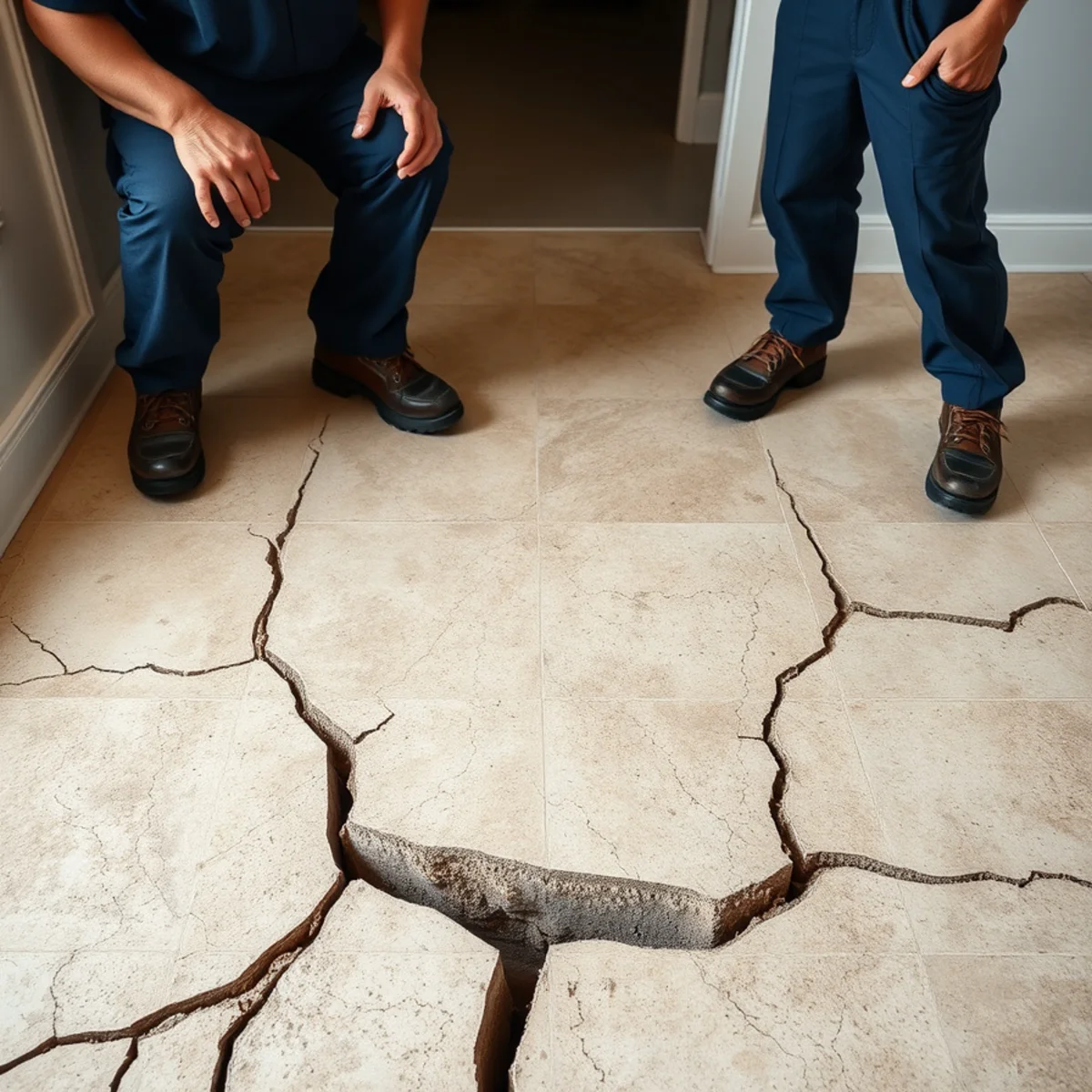
The visible result is cracking — in the slab itself, in tile and grout above it, and in interior drywall where the frame has been forced slightly out of square. Doors that stick seasonally are another sign.
Soil moves the pipe, the pipe wets the soil
This is the part that catches people out, because cause and effect run in a circle.
- Seasonal soil movement stresses a buried pipe until it cracks or develops a pinhole
- The leak saturates soil in one localized area under the slab
- That saturated clay swells more than the surrounding soil
- Differential swelling lifts part of the slab, cracking tile and drywall above
- The homeowner sees cracks and thinks foundation settlement
- A structural engineer gets called before anyone checks for a leak
We have been on jobs in Bellflower and Downey where exactly this had happened — cracks in kitchen tile that the homeowner reasonably read as settlement, which turned out to be a hot-water line leaking under the cabinet run. The fix was a reroute and drying, not anything structural.
What you can actually do about it
You cannot change the soil. What you can do is reduce the moisture swings that drive the cycling, which genuinely helps.
- Keep drainage consistent around the whole perimeter — the goal is even moisture, not dry soil
- Make sure downspouts discharge well away from the foundation, not against it
- Avoid heavy irrigation right against the house on one side only, which creates differential moisture
- Watch large trees close to the foundation, which draw moisture out of soil on their side
- Clear yard and area drains before the rainy season so water does not pond in one spot
- Act on any suspected leak quickly, because a leak is the most concentrated moisture source there is
Which parts of the service area this hits hardest
Anywhere with slab-on-grade housing on the old river-deposited or agricultural ground. That means South Downey below Imperial Highway, the Apollo neighborhood, the Warren High subdivisions, and — outside the city — Bellflower's former orchard land, Pico Rivera's old dairy ground, and the planned tracts of Cerritos and Lakewood.
Lakewood is the extreme case, because roughly 17,500 homes went up there in about three years, which means an entire city's plumbing was buried in this soil at the same moment and reaches the end of its service life together.
Frequently asked
In this soil, check for a leak first — it is cheaper to rule out and it is the cause more often than people expect. A slab leak saturates soil locally, expansive clay swells where it gets wet, and the differential movement cracks tile, grout and drywall above. If the cracks came with a musty smell, a warm floor spot, or an unexplained water bill, a moisture survey should come before a structural engineer.
Not really, but you can reduce the swings that cause damage. The objective is consistent moisture around the whole perimeter rather than dry soil — so keep downspouts discharging away from the foundation, avoid heavy irrigation on one side only, clear drains before the rainy season so water does not pond in one place, and fix leaks promptly since they are the most concentrated moisture source there is.
Because they respond differently to being flexed. Copper is ductile — repeated seasonal movement work-hardens and fatigues it until a small breach opens, usually at a bend or junction. Cast iron is rigid and brittle, so it cannot absorb the movement and cracks instead, typically along the bottom of a horizontal run where corrosion has already thinned it.
The feedback loop worth understanding
Cause and effect run in a circle here. Soil movement stresses a pipe until it leaks; the leak saturates soil locally; that clay swells more than its surroundings; the differential lifts part of the slab and cracks the tile above — and the homeowner reads it as settlement.
So in this soil, new cracks are worth checking for a leak before investigating as settlement. Metering answers it in about an hour and costs a fraction of a structural assessment.
You cannot change the soil, but you can reduce the swings that damage things. Aim for even moisture around the whole perimeter rather than dry soil: extend every downspout, distribute irrigation evenly, and clear drains before the season.
Services mentioned in this article
Slab Leak Water Damage Restoration
Detection, controlled slab access, and drying of the flooring and wall bases the leak has been quietly soaking.
Learn moreLeak Detection & Repair Coordination
Acoustic, thermal, and pressure testing that pinpoints the leak — so the repair opens one small area, not the whole floor.
Learn moreMold Remediation
Contained removal that fixes the moisture source first — because mold that is only cleaned off comes straight back.
Learn moreAreas covered in this article
Established 1950s–60s streets around Furman Park on Rives Ave — original slab-on-grade construction with cast-iron…
about 5 minutes from our Florence Ave baseBellflowerBuilt on former orchard and farmland — 1950s–60s tract homes sitting on clay-loam soil that expands and contracts h…
about 10 minutes from our Downey base