Downey & LA County
Why Downey's Post-War Bungalows Are a Galvanized-Pipe Failure Crisis
It was designed to last fifty years. North Downey's is at seventy-five. This is not deterioration — it is expiry, arriving neighborhood by neighborhood.
The short answer
Galvanized steel pipe was designed to last about fifty years. Downey's post-war bungalow belt — North Downey, the Woodruff/Florence corridor and Studebaker/Firestone — is now at seventy to eighty. That is not deterioration, it is expiry, and it arrives neighborhood by neighborhood.
Downey filled in fast after the war. Vultee Aircraft had been the city's largest employer during World War II, producing a substantial share of America's military aircraft, and North American Aviation took over the plant in 1948 — the operation that would later become Rockwell International and build the Apollo spacecraft.
All those workers needed somewhere to live. The bungalow belt across North Downey, the Woodruff/Florence corridor, and the Studebaker/Firestone area went up through the 1940s and 50s to house them, quickly and to the standards of the day.
Those standards included galvanized steel supply pipe, which had a design life of about fifty years. Do the arithmetic and you get the reason we take so many burst-pipe calls in this city.
How galvanized steel fails
It corrodes from the inside out, and the sequence is entirely predictable.
- The zinc coating that gives galvanized pipe its name erodes off the interior wall over decades of water flow
- The bare steel underneath begins to corrode
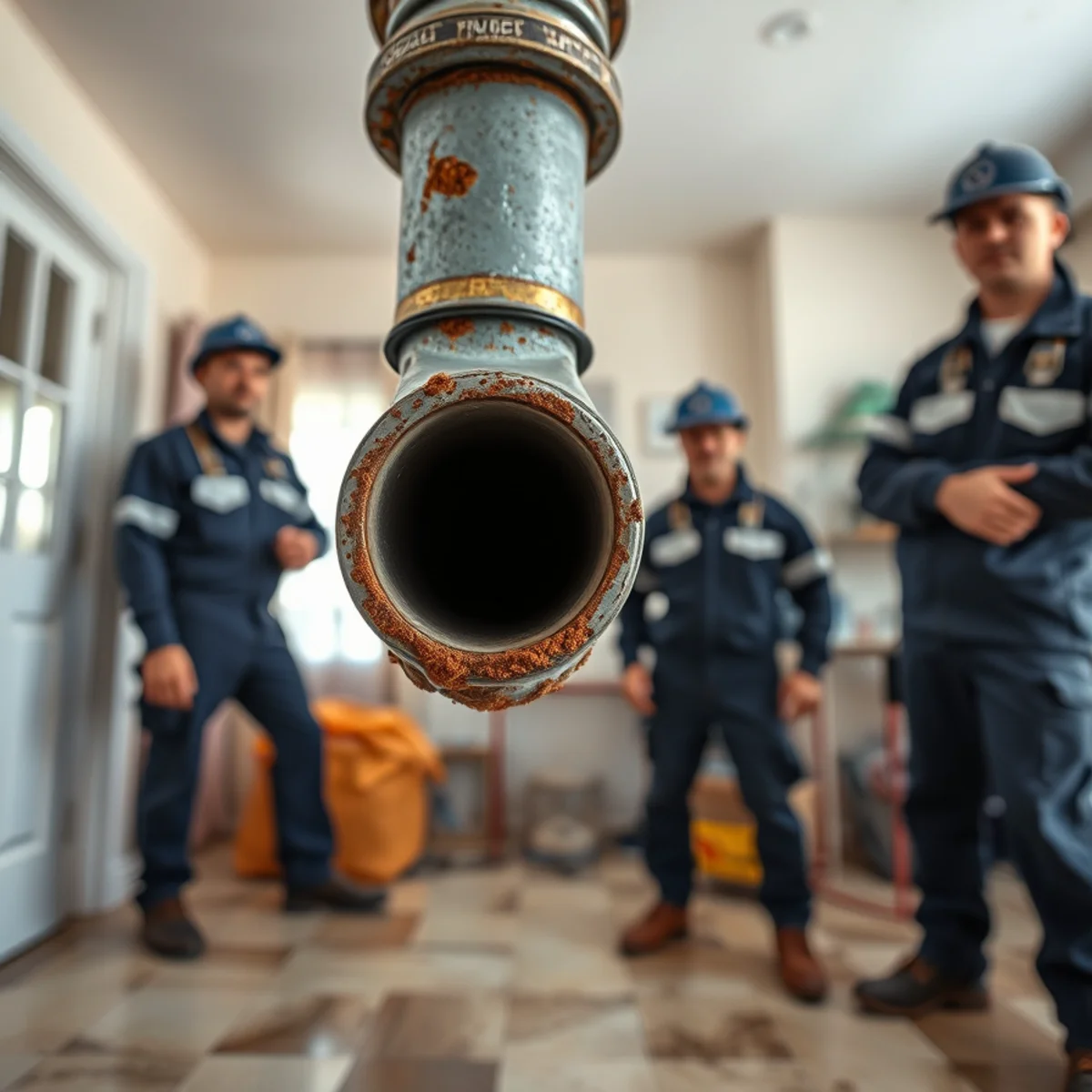
- Rust builds into a hard scale on the inside of the pipe, narrowing the bore
- Water velocity and pressure rise inside the shrinking channel, while the pipe wall gets thinner
- A section fails — almost always at a threaded joint, where the wall was thinnest to begin with, and almost always inside a wall cavity
The warning signs, and why nobody acts on them
| Sign | What it means | Why it gets ignored |
|---|---|---|
| Rust-tinted water after a tap has sat overnight | Rust scale shedding from the interior of your pipes | Assumed to be the city's water |
| Water pressure declining over years | The bore narrowing as scale builds | Too gradual to notice — it feels normal |
| Pinhole leaks appearing more often | Pipe wall thinning to the point of breach | Each one gets patched as an isolated event |
| Discolored water only on the hot side | Hot lines corrode faster — the leading edge of the failure | Blamed on the water heater |
The pattern in that right-hand column is the real problem. Every individual symptom has a plausible innocent explanation, so the system reaches the end of its life while the homeowner treats each signal as a separate minor annoyance.
Where the concentration is highest
North Downey has the highest density of pre-1960 homes in the city, which makes it the oldest galvanized stock we work on. The Woodruff/Florence corridor — the dense post-war housing along Florence Avenue, where our own base sits — is close behind. Studebaker/Firestone, the worker housing behind the industrial corridor, is the third.
Immediately across the city lines, eastern Bell Gardens and northern Paramount have the same housing built in the same years for the same workforce. The city boundary is administrative; the plumbing does not know about it.
The raised-foundation complication
Most of this housing sits on a raised foundation with a crawl space underneath, and that changes where the evidence goes.
On a slab, a leak makes a puddle you can see. On a raised foundation, a leak under the house drains into the crawl space and collects on the soil, out of sight. There is no stain, no drip, no obvious sign — and the first symptom is often a musty smell, because air from a crawl space rises into the living space through floor penetrations and plumbing chases.
We have found standing water across a third of a crawl space in houses where the owners had noticed nothing but a smell they could not place for two months. On this housing stock, the crawl space is the first place we look, not the last.
The dissimilar-metal problem
Seventy years produces layers of work. A bathroom added in the 1970s in copper. A kitchen remodelled in the 2000s. Each of those ties new pipe into the old galvanized, and the junction between dissimilar metals corrodes faster than either pipe alone through galvanic action.
So in a partially updated house, the failure often comes at the transition rather than in the middle of a run. Worth knowing if someone tells you the plumbing was 'partly redone' — that may have introduced a new weak point rather than removed one.
The honest advice
We are a restoration company. We make our living on the aftermath, and we would still rather tell you this: if your Downey home is from this era, still has original galvanized supply, and is showing the symptoms above, price a repipe now.
A planned repipe is a scheduled expense with the walls opened where you choose, on a weekday, with your household prepared. A burst at 2 a.m. is that same expense plus extraction, plus drying, plus drywall and paint, plus a claim, plus a deductible, plus whatever the water ruined on its way through.
Most repipes here use PEX, routed overhead through the attic rather than back under the floor. It is flexible enough to tolerate the seasonal soil movement in this basin, it is not subject to the corrosion that killed the galvanized, and future access is a drywall repair rather than a crawl space excavation.
We do not do plumbing, so there is nothing in that recommendation for us either way.
Frequently asked
Find exposed pipe at the water heater or where the supply enters the house. Galvanized is dull gray steel and a magnet sticks to it; copper is reddish-brown and non-magnetic; PEX is flexible plastic. The behavioral signs are just as reliable — rust-tinted water after a tap has sat overnight, gradually declining pressure, and repeat pinhole leaks. In a 1940s or 50s home that has never been repiped, assume galvanized until you have looked.
The rust itself is mainly an aesthetic and taste problem rather than a health hazard at typical levels. What matters more is what it is telling you: rust in the water means the interior of your pipes is actively deteriorating, and that the wall is thinning toward a failure. Treat it as a structural warning about your plumbing rather than a water quality complaint.
You can, and for a first failure in an otherwise sound system it is reasonable. The difficulty in a seventy-year-old galvanized system is that the section that failed is not special — every other run is the same age, the same material, and has corroded on the same schedule. After a second failure, the arithmetic usually favors replacing the system rather than continuing to patch it.
What to do if this describes your house
The warning signs run for months and each has an innocent-sounding explanation, which is exactly why the system reaches the end of its life while the homeowner treats every symptom as a separate annoyance.
Rust-tinted water after a tap has sat overnight is the clearest single indicator. Add gradually declining pressure and pinholes appearing more often, and you have a system telling you it is finished.
A planned repipe is a scheduled expense with the walls opened where you choose. A burst at 2 a.m. is that same expense plus extraction, drying, drywall, paint, a claim and a deductible. We do not perform plumbing, so there is nothing in that advice for us.
Services mentioned in this article
Burst Pipe Cleanup
Shut-off guidance on the phone, extraction on arrival, and the wall cavity dried properly — not just the carpet.
Learn moreSlab Leak Water Damage Restoration
Detection, controlled slab access, and drying of the flooring and wall bases the leak has been quietly soaking.
Learn moreLeak Detection & Repair Coordination
Acoustic, thermal, and pressure testing that pinpoints the leak — so the repair opens one small area, not the whole floor.
Learn moreAreas covered in this article
1940s–50s post-war bungalow belt — the highest concentration of pre-1960 homes in Downey, and the oldest galvanized…
3 to 7 minutes from our Florence Ave baseWoodruff / FlorenceDense 1940s–50s post-war housing along the Florence Ave corridor — the highest concentration of original galvanized…
3 to 5 minutes from our Florence Ave base — our home block