Emergency Guides
Ceiling Leaking During a Storm? What to Do in the Next 30 Minutes
A sagging ceiling is a collapse risk, not a cosmetic problem. Here is the order to do things in while the rain is still falling.
The short answer
If the ceiling is sagging, get everyone out from under it — saturated drywall can release all at once. Cut power to any affected light fixtures, move furniture from the edges of the room, put buckets under active drips, and photograph everything. Do not puncture a bulge yourself; the volume above it is impossible to judge from below.
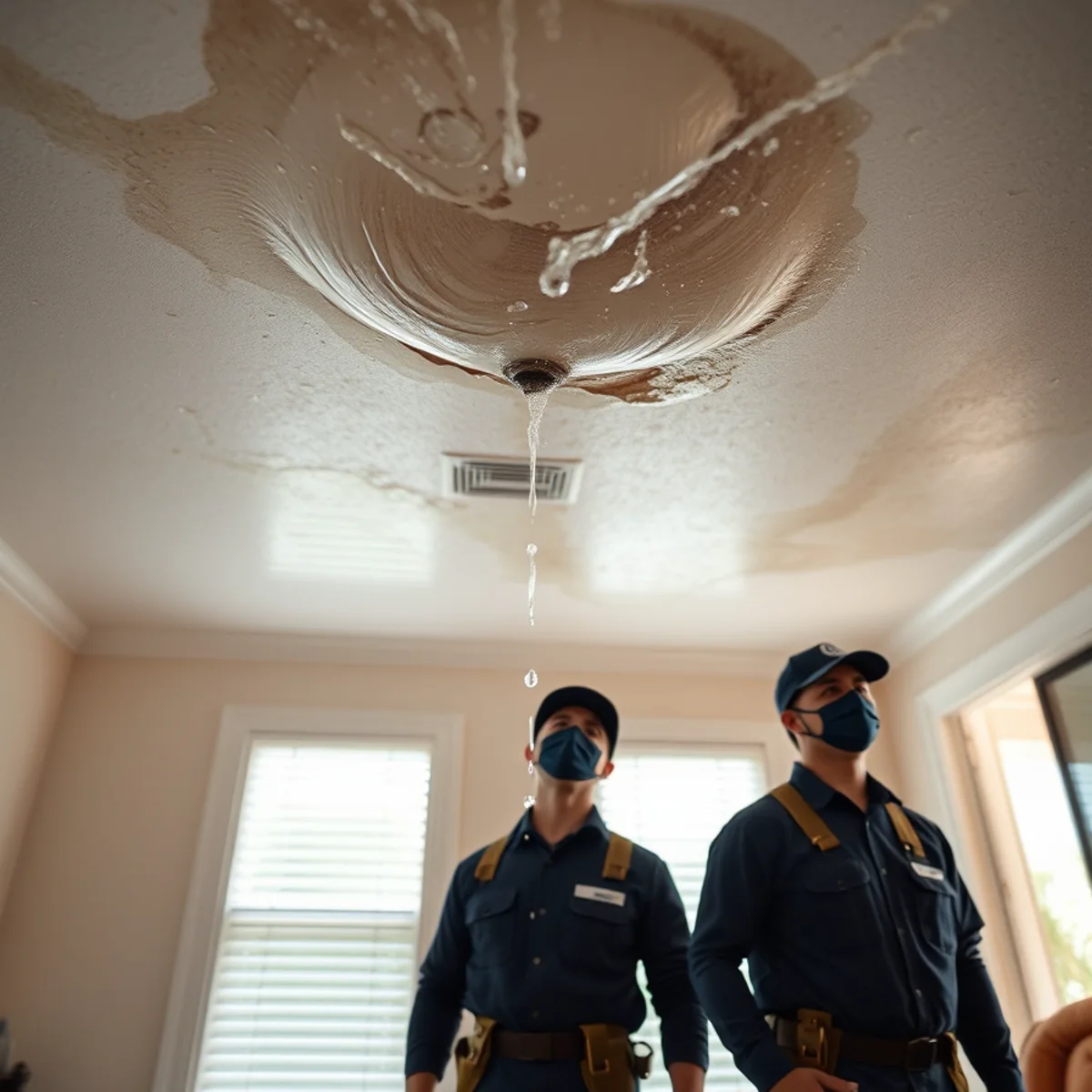
Water is coming through your ceiling and it is still raining. There are three things to sort out in the next half hour, in this order: whether anyone is in danger, what you can save, and who to call.
First: is the ceiling bulging?
A stain is a problem. A bulge is a hazard. If a section of ceiling is sagging or has a visible dome in it, water is pooled up there right now and the drywall is carrying weight it was never designed for.
You will find advice online telling you to poke a hole in the bulge with a screwdriver to relieve it. We would not do that, and we do this for a living. You cannot judge how much water is up there, you are standing directly underneath it, and a controlled release needs the right position and something to catch it. Call us — this is exactly the kind of thing we do at 2 a.m. in the rain.
Second: kill power to that area
If water is coming through or near a light fixture, a ceiling fan, or a smoke detector, switch off the breaker for that circuit. Water traveling along the top of a ceiling reaches electrical boxes, and a fixture that is dripping is a fixture that is energized and wet.
Third: protect what is below
- Move furniture, electronics, and anything with fabric or paper out of the room, working from the edges
- Put down buckets or bins under active drips, with a towel in the bottom to stop splashing
- Lift rugs out entirely rather than trying to dry them in place
- Photograph everything before and during — the ceiling, the drips, the affected contents, and the time
Why the leak is not where the stain is
This is the single most misunderstood thing about ceiling leaks, and it is why so many get repaired twice.
Water entering at a roof penetration does not fall straight down. It runs along the top of a truss or rafter, follows a pipe or a wire, and spreads across the back of the ceiling drywall until it finds a seam, a fixture penetration, or a low point to come through. Fifteen feet between the actual entry point and the visible stain is completely ordinary.
Which is why we trace it with thermal imaging and moisture mapping rather than opening the ceiling where the stain is. Cutting at the stain finds you a wet ceiling and no answer.
What is probably causing it
In Downey's single-story post-war housing, which is most of the city, a storm-time ceiling leak almost always means the roof or something in the attic. The usual suspects, in rough order:
- A cracked plumbing vent boot — the rubber collar where a pipe passes through the roof, dried out and split by years of sun. Probably the most common residential roof leak source there is.
- Failed flashing at a chimney, skylight, or wall intersection
- Tiles or shingles lifted or displaced by a Santa Ana wind event months ago, which leaked nothing until real rain arrived
- Ponding on a flat or low-slope section where a drain has blocked
- An HVAC condensate line backed up and overflowing into the ceiling — this one appears in warm weather, not during storms
In two-story homes and the shared-wall townhomes around Downey Landing, the source is more often the bathroom above — a failed shower pan, a leaking toilet flange seal, or a supply connection under a vanity. The signature there is a stain that grows after someone showers rather than after it rains.
The Santa Ana connection
If your ceiling started leaking in the first real storm of the season, there is a good chance the damage was done months earlier. Santa Ana winds lift and displace roofing, tear flashing loose, and leave openings that do absolutely nothing until water arrives with enough volume and the right wind direction.
That is why we tell people in this city to get the roof looked at after a significant wind event rather than after the ceiling stains. It is the cheapest water damage prevention available here.
What happens next
Emergency tarping first, because Southern California storms arrive in sequences and an open roof will be tested again within days. Then we trace the source, dry the attic and ceiling cavity — including removing saturated insulation, which holds water against the drywall and never usefully dries in place — and only then repair and texture-match the ceiling.
If your ceiling has pre-1980 acoustic popcorn texture, tell us. That may contain asbestos and it is not something to scrape or sand before testing.
Frequently asked
We would not, and we do this professionally. You cannot judge how much water is pooled up there, you would be standing directly underneath it, and a controlled release needs the right position and something to catch several gallons. Keep everyone out of the room and call — relieving a saturated ceiling safely is routine for us and genuinely risky to improvise.
Yes, and it is usually exactly when it needs doing. We run 24/7 through storm events. If conditions are genuinely unsafe to be on a roof — active lightning, or wind still gusting hard — we will say so honestly, secure what we can from inside, and get up there the moment it is safe.
Water travels along the path of least resistance before it drips. It runs along the top of a truss, follows a pipe or wire, and spreads across the back of the drywall until it finds a seam or a fixture penetration. Fifteen feet between source and stain is ordinary, which is why we trace it with thermal imaging rather than opening the ceiling at the stain.
The leak is almost never where the stain is
The single most useful thing to understand about a ceiling leak is that water travels along framing before it drips. Fifteen feet between the entry point and the visible stain is completely ordinary, which is why cutting at the stain finds you a wet ceiling and no answer.
The second is that the cavity above the ceiling has to be dried, not just the drywall below it. Saturated insulation holds water against the ceiling and the joists indefinitely and never usefully dries in place.
If your ceiling started leaking in the first real storm of the season, the damage was probably done months earlier by a Santa Ana wind event. Getting the roof inspected after a wind event, rather than after the ceiling stains, is the cheapest water damage prevention available in this city.
Services mentioned in this article
Ceiling Water Damage Repair
We trace the leak to its real source, dry the cavity above, then repair and texture-match so the patch disappears.
Learn moreStorm Damage Cleanup
Emergency tarping to stop the water first, then extraction, drying, and full documentation for the claim.
Learn moreRoof Leak Water Damage Restoration
Tarping to stop the water, attic and insulation dried out, and the interior restored — with the storm date documented.
Learn moreAreas covered in this article
Named for the historic Studebaker plant and the Firestone Boulevard corridor — 1940s–50s worker housing with origin…
5 to 8 minutes from our Florence Ave baseDowntown DowneyHistoric core along Firestone Blvd and Old River School Rd — 1920s–40s commercial buildings and pre-1960 homes with…
about 6 minutes from our Florence Ave base