Problem Solving
Sewage Backing Up Into the Shower: Causes and Safe Cleanup
It surfaces in the shower because that is the lowest opening in your drain system. Which means the blockage is downstream of everything.
The short answer
Sewage surfaces in the shower because the pan sits at the lowest point in your drain system. That means the blockage is downstream of everything, in the sewer lateral — so stop using every drain in the house immediately, because each gallon you send down comes back up here.
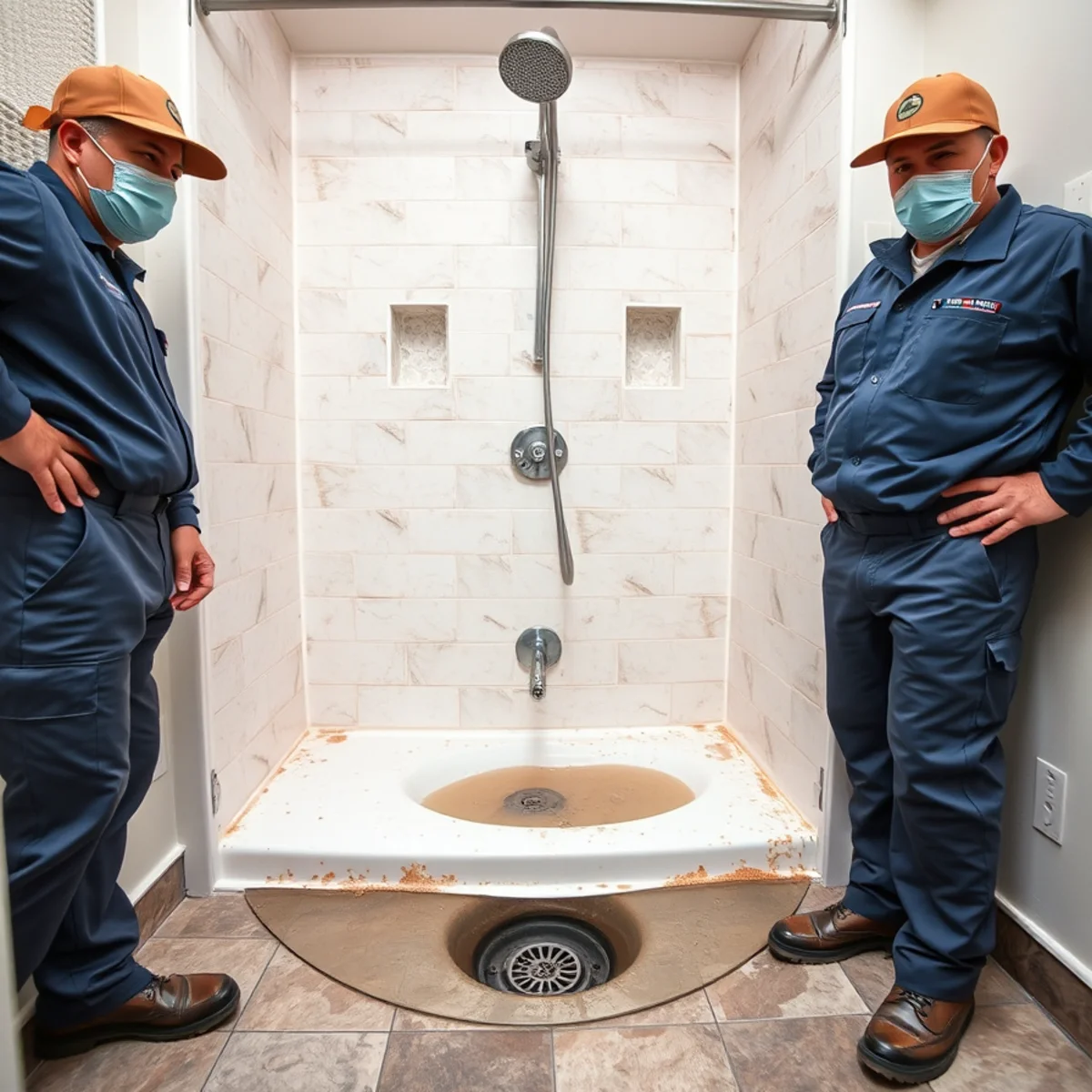
Sewage in the shower is not a shower problem. It is a main line problem that happens to be surfacing at the lowest opening in your drain system — and in most homes, that is the shower pan or a floor drain.
Understanding that changes what you do next, because it means every drain in the house is now connected to the problem.
Why the shower
Your drain system relies on gravity. When a blockage forms downstream — in the sewer lateral running from your house to the street — waste water backs up behind it and fills the pipe. It rises until it finds an opening.
Toilets have a water seal and sit higher. Sinks are mounted well above floor level. A shower pan or a floor drain sits at the lowest point in the system with nothing but a shallow trap between it and the pipe. So that is where it comes out first.
What is causing it
In Downey and the surrounding Gateway Cities, the answer is nearly always one of these:
- Tree roots in a clay-tile lateral — by far the most common in established neighborhoods with mature street trees
- A cracked or collapsed lateral, from decades of clay soil movement
- Grease and solids accumulation narrowing the line over years
- Groundwater infiltration during a wet winter, overloading a marginal line
- A municipal main issue, which is rarer but does happen — usually affecting several houses at once
- Bellied or offset pipe, where a section has sagged and collects solids
The health risk is real
Sewage carries E. coli, salmonella, hepatitis A, rotavirus, giardia, and cryptosporidium. Exposure routes include direct contact, ingestion via contaminated hands, and inhalation of aerosolized particles.
That last route is why the single most harmful thing people do is set up a box fan to dry it out. Fans aerosolize contamination into the air the household is breathing, and they distribute it to rooms that were clean.
What not to do
- Do not run fans on it — this is the mistake that turns a bathroom problem into a house problem
- Do not use a household or shop vacuum
- Do not mop, which spreads it across a wider area and contaminates the mop and bucket
- Do not pour drain cleaner down the line — it will not clear a root mat and it makes the water hazardous for anyone working on it
- Do not keep flushing to see if it clears
- Do not let children or pets into the area, at all
- Do not run the HVAC if it serves that area, which distributes contamination through the ducts
What actually happens on a proper cleanup
Containment first — sealed barriers with negative air pressure so contaminated air flows into HEPA filtration rather than into your living space. Then the line gets cleared, because cleaning up around an active backup accomplishes nothing.
Then extraction with dedicated equipment, removal of all porous material that absorbed it, physical cleaning followed by hospital-grade disinfection with full dwell times, and only then drying. Odor gets treated by removing the contaminated material rather than by masking it.
The warning you almost certainly had
Root blockages announce themselves for months, and the signals are easy to write off individually.
- A shower or tub draining slower than it used to
- A toilet gurgling when the washing machine discharges — fixtures talking to each other always means the shared line
- Multiple drains slow at the same time
- A backup that clears itself, which is the most dangerous signal of all
A backup that clears itself has not resolved. It means the blockage is nearly complete and something shifted enough to let flow resume. A camera scope at that point costs a small fraction of a sewage cleanup.
Fixing it so it does not recur
Clearing the blockage restores flow; it does not fix the pipe. If roots got in, the joints are open and roots will return — typically within a year or two.
The durable fix is lining the lateral: a resin liner cured in place inside the existing pipe, sealing the joints from the inside so roots cannot re-enter. No trench, and the mature street tree stays where it is. Full excavation is reserved for pipe that has collapsed or is badly offset, where lining cannot work.
Worth checking your declarations page too. Sewer and water backup coverage is commonly excluded by default on California policies and is usually inexpensive to add — and it cannot be added after the backup.
Frequently asked
Because the shower pan sits at the lowest point in your drain system with only a shallow trap between it and the pipe. Toilets have a water seal and sit higher; sinks are mounted well above floor level. When a blockage downstream fills the line, it rises until it finds the lowest opening — which is your shower or a floor drain.
No. Every gallon you send down any drain arrives at the blockage and comes back up at the lowest opening. That includes flushing, running a tap, a washing machine cycle, or a dishwasher. Stop all water use in the house until the line has been cleared.
Not on its own. Clearing restores flow but leaves the pipe as it was, and if roots got in through open joints they will return, typically within a year or two. The durable fix is lining the lateral — a resin liner cured in place that seals the joints from the inside, with no trench and no need to remove the tree.
Stop the water use, then get out of the room
The most harmful thing people do is set up a box fan to dry it out. Sewage carries E. coli, salmonella, hepatitis A, rotavirus and parasites, and fans aerosolize that into the air the household is breathing.
Clearing the blockage restores flow but does not fix the pipe. If roots got in through open joints they will return within a year or two — the durable fix is lining the lateral from the inside, which needs no trench and lets the tree stay.
Check your declarations page for a sewer and water backup endorsement. It is commonly excluded by default on California policies and cannot be added after the event.
Services mentioned in this article
Sewage Cleanup & Backup Removal
Category 3 backups handled under containment — full protective equipment, regulated disposal, and verified disinfection.
Learn moreMold Remediation
Contained removal that fixes the moisture source first — because mold that is only cleaned off comes straight back.
Learn more24/7 Emergency Water Removal
A person answers, 24/7. Crews dispatched within 60 minutes — nights, weekends, and holidays included.
Learn moreAreas covered in this article
Formed from the old hay-shipping communities of Hynes and Clearwater — 1940s–50s war-worker housing and 1960s tract…
about 10 minutes from our Downey baseLynwoodA 1940s–50s industrial suburb where high rental density and aging infrastructure produce recurring water-loss and s…
about 14 minutes from our Downey base